
RC Cellmeter 7
4.7Editor score
Checks multiple battery cell types
Compact and lightweight design
Displays individual cell voltages
This guide compares the top ten lithium ion battery testers for 2026. We analyze features, accuracy, and compatibility to help you find the perfect tool for
Finding the right lithium ion battery tester is crucial for maintaining your electronics and vehicles. These devices ensure your power sources are safe and functioning correctly before they fail unexpectedly.
We compared ten highly rated testers based on accuracy, ease of use, and compatibility. Our analysis covers automotive tools and portable chargers to give you a comprehensive overview of the market.
Each pick highlights key features and real-world performance to help you decide. Prices and availability change often so please verify details before purchasing the tool that fits your budget.
4.7Editor score

4.5Editor score

4.5Editor score
The following table provides a side-by-side comparison of the top ten lithium ion battery testers. Review the specifications to find the model that matches your technical requirements.


The ANCEL BT410 stands out as a versatile tool for testing both traditional and modern battery systems. It handles 12V and 24V setups while supporting lithium-ion chemistry which is rare at this price point.
We may earn a commission when you buy through this link, at no additional cost to you.
Its smart chip delivers nearly perfect accuracy and the color screen makes reading results easy in any lighting. You get detailed diagnostics like internal resistance and state of health without needing a separate device.
While the unit is robust some users find the menu system takes time to master fully. The cables are long which helps in tight engine bays but the device itself might be bulky for small glove compartments.
This tester is ideal for fleet owners or DIYers with multiple vehicle types. Its ability to pinpoint alternator issues saves money and ensures you never replace a good battery unnecessarily.
Unlike many testers that only handle lead-acid, this unit accurately measures lithium-ion batteries common in modern EVs and hybrids.
The QR code feature lets you send test results directly to a mechanic or keep digital records of your battery health over time.
We may earn a commission when you buy through this link, at no additional cost to you.
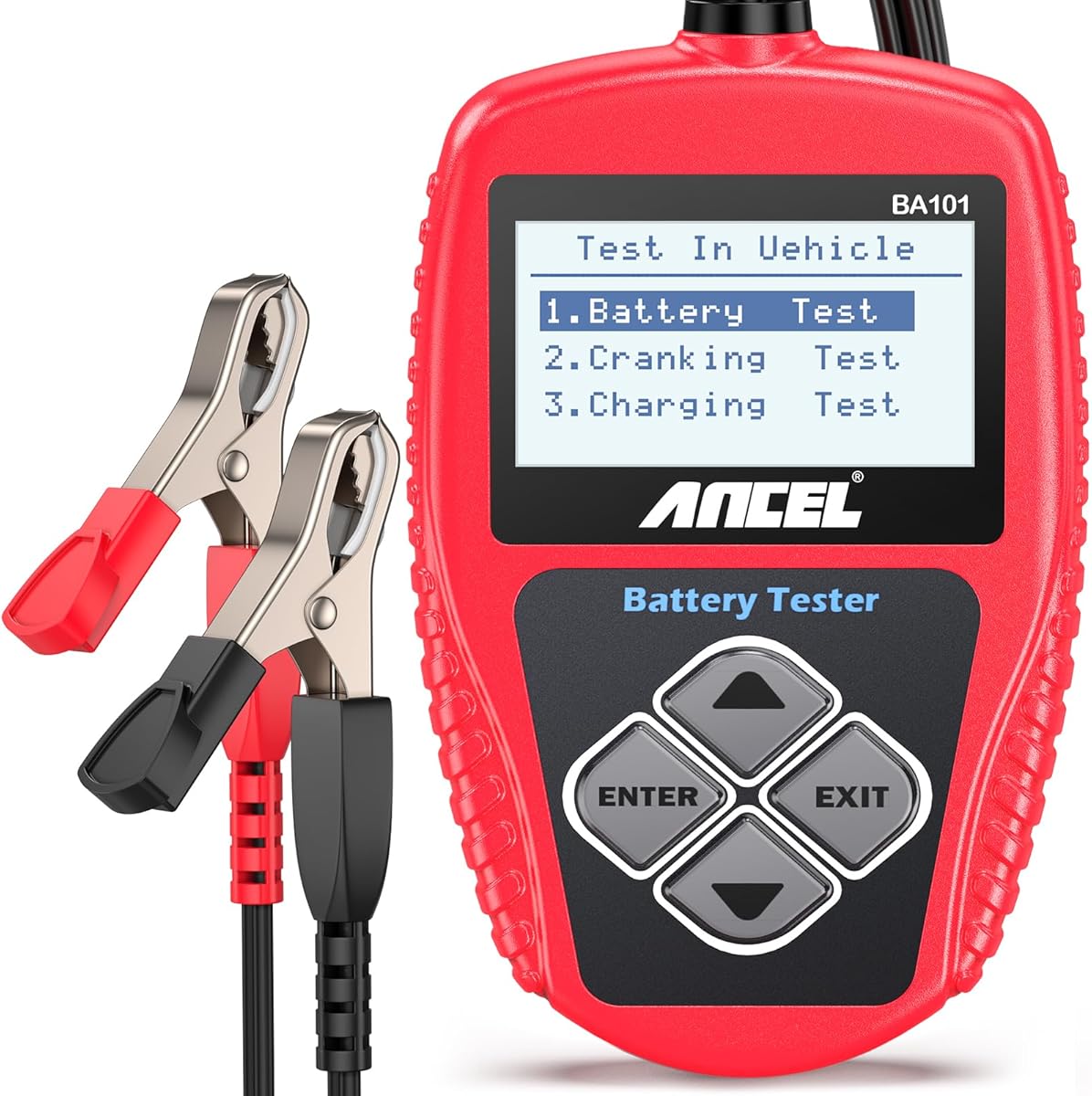
The ANCEL BA101 is a reliable workhorse featured in popular automotive testing videos for its consistent results. It focuses on 12V systems which covers most standard cars and light trucks effectively.
We may earn a commission when you buy through this link, at no additional cost to you.
Testing is straightforward with clear instructions that guide you through entering battery ratings. The black and white screen with backlight ensures readability even in direct sunlight or dark garages.
It lacks 24V capability which limits heavy-duty truck use and does not store internal battery history without external tools. However for basic health checks it performs admirably at a very affordable price.
Choose this if you need a straightforward tool for regular maintenance without advanced data logging. Its durability and ease of use make it perfect for home garage enthusiasts.
Built with a precision smart chip the BA101 delivers reliable readings that help you avoid unnecessary battery replacements.
Multiple protections guard against reverse polarity and short circuits ensuring your vehicle and the device stay safe during testing.
We may earn a commission when you buy through this link, at no additional cost to you.
This module is designed specifically for hobbyists working with 18650 lithium cells in custom batteries or power banks. It measures actual capacity rather than just voltage which is critical for performance.
We may earn a commission when you buy through this link, at no additional cost to you.
The four channels allow you to test a whole battery pack simultaneously saving significant time during maintenance. The screen shows internal resistance helping you identify weak cells quickly.
It is not a plug-and-play automotive tool but rather a component tester that requires some technical knowledge. The build is functional but not rugged so handle it with care during disassembly tasks.
Use this if you build your own power systems or repair lithium packs for tools. It gives the detailed metrics needed to ensure your custom battery packs are safe and efficient.
Unlike simple voltage meters this tester discharges the cell to measure real capacity ensuring you know exactly how much energy it holds.
High internal resistance indicates aging or damage helping you remove weak cells before they cause safety issues in your builds.
We may earn a commission when you buy through this link, at no additional cost to you.
The ANCEL BT310 is notable for its ability to store and review past test data. This feature helps you monitor battery degradation trends which is vital for preventing unexpected failures.
We may earn a commission when you buy through this link, at no additional cost to you.
It supports both 12V and 24V systems and works with lithium-ion batteries offering wide versatility. The five-way result system simplifies diagnostics for users who are not automotive experts.
The black and white LCD is clear but lacks the color appeal of the BT410. You must enter accurate CCA values for correct readings and it lacks the sharing capabilities of newer models.
Ideal for those managing multiple vehicles it helps you see which battery is weakening before it dies. The ability to compare past reports makes proactive maintenance much easier.
The built-in review function lets you pull up previous test reports to see how your battery health changes month over month.
Clear five-step results guide you to a decision whether to charge or replace the battery without complex number interpretation.
We may earn a commission when you buy through this link, at no additional cost to you.
The TOPDON BT100 is designed for convenience with a compact size that fits easily in a glove box. It uses a passive testing method to ensure safety without drawing power from your device.
We may earn a commission when you buy through this link, at no additional cost to you.
Three color LEDs give immediate feedback on battery health allowing you to see results at a glance. The menu system is intuitive making it easy for anyone to operate quickly.
It lacks the detailed data logging of premium models and does not support 24V heavy trucks. However for standard 12V passenger vehicles it provides reliable and safe testing results.
Perfect for casual drivers who want a quick check without technical hassle. Its portability means you always have a tool available when you suspect a weak battery.
This tester only powers on when correctly attached reducing the risk of accidental shorts or sparks during the connection process.
Its small footprint makes it easy to store in your car ensuring you have a diagnostic tool ready whenever you need it.
We may earn a commission when you buy through this link, at no additional cost to you.
The RC Cellmeter 7 is an affordable device specifically designed for RC hobbyists and small electronics. It checks individual cell voltages to help maintain balance in multi-cell packs.
We may earn a commission when you buy through this link, at no additional cost to you.
Weighing only 45 grams it is incredibly portable and easy to carry in a toolbox. The display shows the lowest and highest cell voltages helping you spot imbalances immediately.
It does not measure actual capacity so it cannot tell you how much energy a battery holds. The build is functional but not rugged so avoid dropping it or exposing it to moisture.
Best for drone flyers and modelers who need to check cell balance before flights. It is a necessary tool to prevent crashes caused by sudden power drops in unbalanced packs.
By showing the gap between highest and lowest cells this meter helps you maintain safe charge levels across your battery pack.
At under 50 grams it is easy to keep with your flight gear ensuring you never leave home without checking your power source.
We may earn a commission when you buy through this link, at no additional cost to you.
The FOXWELL BT705 is a professional grade tester used in industry comparisons for its reliability. Its long cable allows you to start the engine from the driver seat without a helper.
We may earn a commission when you buy through this link, at no additional cost to you.
The clear prompts guide you through complex tests reducing the chance of user error. A hard carrying case keeps the device and accessories organized and protected during transport.
It is pricier than basic models and larger making it less convenient for casual home storage. But for mechanics or serious enthusiasts the build quality justifies the investment.
Choose this if you need professional accuracy and durability. It is ideal for those who test batteries frequently and want a tool that will last for years of heavy use.
The long cable reach means you can test cranking voltage while sitting in the seat without needing someone else to turn the key.
Step-by-step instructions on the screen simplify complex diagnostics making pro-level testing accessible to non-experts.
We may earn a commission when you buy through this link, at no additional cost to you.
The FOXWELL BT705Plus upgrades the previous model with a faster processor and a vibrant color display. It delivers results significantly quicker making workflow much more efficient.
We may earn a commission when you buy through this link, at no additional cost to you.
It excels at testing low-voltage batteries where other units might struggle. The color screen offers better readability in bright conditions and the storage box keeps everything secure.
It is the most expensive option and does not support lithium battery cells specifically. However for lead-acid systems it offers the best performance and clarity available on the market.
This is the top choice for professionals who demand speed and accuracy. The improved hardware ensures you spend less time waiting and more time fixing vehicles efficiently.
Upgraded algorithms deliver test results up to 30 percent faster than previous versions improving overall workflow efficiency.
The high-contrast color LCD ensures every detail is visible even in bright sunlight without needing additional lighting.
We may earn a commission when you buy through this link, at no additional cost to you.
This tester is perfect for checking household batteries like AA and 9V. The magnetic slot holds the battery securely so you do not need to hold it manually during testing.
We may earn a commission when you buy through this link, at no additional cost to you.
It is rechargeable via USB-C eliminating the need for disposable batteries in the tester itself. A single charge lasts for fifteen hours of use making it very convenient.
It only provides a general health status rather than detailed diagnostic data. It is not intended for automotive or heavy-duty use but serves well for everyday household needs.
Ideal for keeping in a kitchen drawer or toolbox for general checks. The ease of use means anyone in the house can quickly verify if a battery is good.
The magnetic slider locks the battery in place preventing accidental drops or slips during the testing process.
Built-in USB-C charging means you never have to buy replacement batteries for the tester itself.
We may earn a commission when you buy through this link, at no additional cost to you.
The La Crosse tester is a simple device designed for quick checks of common battery sizes. You select the voltage range and slide the battery into the tray for an instant result.
We may earn a commission when you buy through this link, at no additional cost to you.
It uses a mechanical tray to ensure correct connection making it foolproof for general use. The size is small enough to keep anywhere for when you need a quick check.
It lacks any digital features or advanced diagnostics. It is strictly for determining if a battery has enough power for immediate use in toys or remotes.
Perfect for a drawer of spare batteries to ensure you grab a charged one. Its simplicity and low cost make it a reliable backup tool for basic needs.
The physical tray mechanism ensures correct contact every time without needing electronic setup or calibration.
Small enough to fit in a desk drawer or glove box it takes up almost no space in your home or car.
We may earn a commission when you buy through this link, at no additional cost to you.
Selecting the right tester depends on your specific needs whether you manage cars or hobby electronics. This guide breaks down the critical factors to consider.
Ensure the device supports the specific chemical type of your batteries. While most automotive testers handle lead-acid only some advanced models support lithium-ion chemistry for modern vehicles.
Check the manufacturer specifications for compatibility before purchasing to avoid buying a tool that cannot measure your specific battery type.
Determine if you need to test only 12V systems or 24V commercial vehicles as well. Some units are limited to 12V which saves cost but limits heavy-duty applications.
Choose a dual-voltage tester if you own both light cars and larger trucks to ensure full coverage across your entire vehicle fleet.
Look for models with advanced smart chips that offer high accuracy like 99 percent or better. This ensures you get reliable data and avoid unnecessary replacements.
Higher accuracy helps in diagnosing subtle issues that cheaper testers might miss leading to better long-term maintenance decisions.
Consider whether you prefer a color LCD or a simple LED indicator based on your environment. Color screens provide more detailed data while LEDs offer quick glance feedback.
A high-contrast display is essential if you frequently test in bright sunlight or dark garages for clear visibility.
Long cables are beneficial for reaching battery terminals in modern cars where the battery is hidden or recessed. Standard lengths can make testing difficult in tight engine bays.
Opt for a model with extra-long cables if your vehicles have difficult-to-reach batteries to simplify the testing process.
Some testers store test history or generate shareable reports via QR codes for digital records. This is useful for tracking battery health over time or sharing with mechanics.
If you need to monitor degradation trends a model with data retention features will help you plan maintenance schedules proactively.
Look for built-in protections against reverse polarity and short circuits to safeguard your vehicle electronics. These features prevent accidental damage during incorrect connections.
Always ensure the device has multiple safety layers to protect both your expensive equipment and the tester itself from electrical faults.
Consider the size and weight if you plan to store the tool in a glove box or carry it for roadside checks. Compact units are easier to store but may lack advanced features.
Balance the need for portability with the functionality you require to ensure the tool is always accessible when needed.
Always clean battery terminals with a wire brush before testing to ensure a secure connection. Corrosion or dirt can lead to false readings and inaccurate diagnostic results.
Follow the specific steps on your device screen such as selecting the correct CCA rating to get valid data. Entering the wrong values may lead to incorrect health assessments.
Store the tester in a dry place and check the clamps regularly for wear or damage. Proper care ensures the device remains accurate and safe for long-term use.
Generally no because the internal chemistry and voltage curves differ significantly. Using a standard tester on lithium can lead to inaccurate health readings or damage the unit.
CCA stands for Cold Cranking Amps which measures the battery's ability to start an engine in cold temperatures. Your tester needs to know this value to judge performance accurately.
No these devices are for diagnostics and load testing only. They do not provide charging capabilities so you must use a dedicated charger to recharge a battery.
It is recommended to test your battery twice a year especially before extreme seasons. Regular checks help catch issues early before they strand you unexpectedly.
SOC indicates the current charge level while SOH measures the overall health compared to a new battery. Both are needed to determine if a battery needs replacing.
Yes modern testers include safety features like reverse polarity protection to prevent accidents. Many models also feature long cables for solo operation without an assistant.
Most household batteries are tested with simple voltage testers rather than load testers. Automotive load testers are designed for high capacity batteries and may not work for small cells.
We reviewed ten excellent options ranging from automotive load testers to household voltage checkers. The ANCEL BT410 stands out for its versatility with lithium and lead-acid systems.
Prioritize safety and accuracy when selecting a tool to ensure you get reliable data every time. Features like reverse polarity protection and clear displays are worth the extra investment.
Prices and availability change regularly so check the current listings before making your final purchase decision. Always verify the compatibility with your specific battery type for best results.