
Portable UHF VHF Frequency Counter
4.1Editor score
Compact mini size
One button control
Affordable pricing
This guide compares the top frequency counter for ham radio options to help you choose the best portable tool for accurate signal measurement and tuning.
Finding the right frequency counter for ham radio is essential for accurate signal measurement and tuning. These devices help operators verify transmit frequencies and ensure compliance with band plans. A good counter offers precision, portability, and ease of use for both field and station work.
We evaluated ten top-rated frequency counters based on accuracy, range, features, and user feedback. Our comparison includes handheld meters, spectrum analyzers, and high-precision modules. Each product was assessed for its ability to handle VHF, UHF, and HF signals commonly used by amateur radio operators.
Each pick shows key strengths, weaknesses, and ideal use cases to help you decide. Note that availability and pricing may change over time. We recommend checking current listings before purchasing to ensure you get the best value for your specific radio needs.
4.1Editor score

4.1Editor score

5.0Editor score
Below is a side-by-side comparison of all ten frequency counters evaluated in this guide. Each entry highlights core specifications to help you quickly identify the best fit for your ham radio operations.


The Mcbazel Surecom SF401 Plus stands out as a top choice for ham radio operators needing reliable frequency measurement. With a solid 4.1 rating and support for frequencies from 27MHz to 3000MHz, it handles most VHF and UHF bands effectively.
We may earn a commission when you buy through this link, at no additional cost to you.
Its TCXO temperature compensation ensures accuracy within 2 to 4ppm across a wide temperature range, making it suitable for field use. The inclusion of VHF and UHF antennas plus an AC adapter adds value. The four button control makes operation straightforward even in quick testing scenarios.
While it measures continuous wave signals well, it is not intended for wide bandwidth analysis. Users must avoid direct access to high power radio outputs to prevent damage. These trade-offs are acceptable for the price and functionality offered by this compact meter.
If you need a portable frequency counter for ham radio that balances performance and cost, this model is a strong recommendation. It serves maintenance personnel and enthusiasts alike by verifying transmit frequencies and ensuring compliance with band plans efficiently.
The built-in TCXO oscillator maintains accuracy across temperatures from minus 45 to 65 Celsius, ensuring reliable readings in varied environments.
Included antennas for VHF and UHF plus an AC adapter mean you can start measuring immediately without needing extra accessories.
We may earn a commission when you buy through this link, at no additional cost to you.
The Surecom SF401 Plus earns a higher user rating of 4.3 by delivering consistent performance for walkie talkie and two way radio testing. It measures continuous carrier signals across 27MHz to 3000MHz, making it versatile for most amateur radio bands.
We may earn a commission when you buy through this link, at no additional cost to you.
A key strength is the signal strength indicator, which helps operators gauge transmission quality alongside frequency accuracy. The four button control is intuitive, and the compact size allows easy transport to remote locations. TCXO technology keeps drift minimal even in changing temperatures.
However, like other counters in this category, it focuses on continuous wave signals and may not suit complex modulation analysis. Direct high power inputs must be avoided to protect the device. These limitations are typical for handheld units in this price range.
This model is an excellent choice for enthusiasts who want dependable frequency verification without complex setup. Its reliability and ease of use make it a favorite for routine checks and maintenance tasks in ham radio operations.
Beyond frequency reading, the signal strength indicator helps users assess transmission quality and antenna performance during field tests.
The four button design simplifies range selection and measurement, allowing quick operation even for less experienced users.
We may earn a commission when you buy through this link, at no additional cost to you.
The FC-2800M Frequency Counter offers a compelling mix of features for ham radio and CB use with a 4.4 rating. Its ability to measure from 2MHz to 2800MHz covers HF, VHF, and UHF bands, while DMR digital mode support adds modern relevance.
We may earn a commission when you buy through this link, at no additional cost to you.
Built-in CTCSS and DCS decoders streamline testing for encoded transmissions. The high precision PPM crystal time base ensures accurate readings. A two year warranty provides peace of mind, and the four button interface keeps operation simple during field work.
While the compact design enhances portability, some users may prefer larger displays for extended use. Proper setup is essential to avoid signal overload. These trade-offs are minimal given the device supports both analog and digital radio modes effectively.
Choose this counter if you need a DMR compatible meter with solid accuracy and warranty support. It balances affordability with features that matter to modern amateur radio operators and CB enthusiasts alike.
Digital mode capability allows accurate frequency measurement for DMR radios, expanding utility beyond traditional analog two way systems.
The two year warranty ensures long-term reliability and support, making this a low-risk investment for regular frequency checking.
We may earn a commission when you buy through this link, at no additional cost to you.
The Portable TinySA Spectrum Analyzer stands apart with visual spectrum analysis capabilities rated at 4.4. Covering 100kHz to 960MHz, it offers more than simple frequency counting, enabling users to view signal distribution across bands for deeper RF insight.
We may earn a commission when you buy through this link, at no additional cost to you.
A 2.8 inch touchscreen makes navigation intuitive, and the built-in signal generator adds testing flexibility. USB PC control allows remote settings adjustments, while the rechargeable battery supports field operations. The included antenna and cables facilitate immediate use.
Its upper frequency limit is lower than some counters, but the visual feedback is invaluable for interference hunting. The learning curve is steeper than basic counters, yet the added functionality justifies the effort for advanced users.
This analyzer is ideal for ham radio operators seeking spectrum visualization alongside frequency measurement. It bridges the gap between basic counters and professional lab gear, making complex RF tasks accessible in a portable form.
The color display shows up to 290 scan points, helping users identify interfering signals and harmonics visually.
Built-in sine and square wave outputs allow self-testing and calibration without needing external signal sources.
We may earn a commission when you buy through this link, at no additional cost to you.
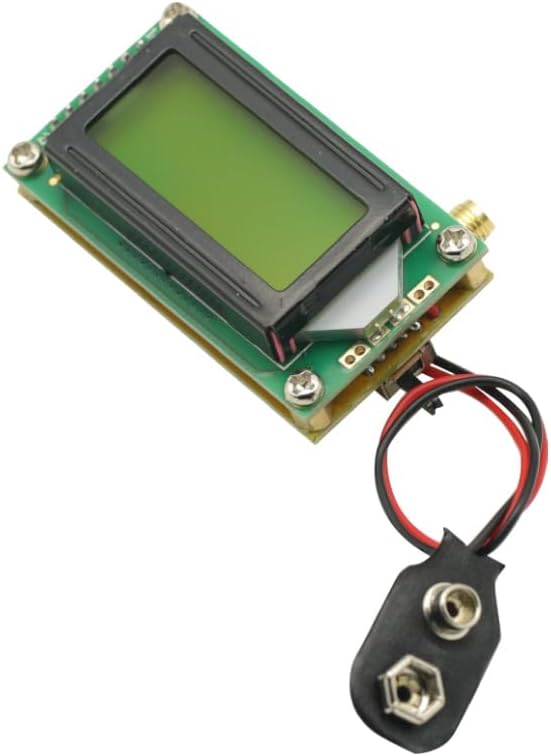
The Portable UHF VHF Frequency Counter delivers exceptional value with a 4.1 rating and minimal cost. Targeting 136 to 174MHz VHF and 400 to 470MHz UHF, it covers the most common ham radio local communication bands efficiently.
We may earn a commission when you buy through this link, at no additional cost to you.
Its nine by five point five by two centimeter size makes it the smallest option reviewed. One button control simplifies use, and the included nine volt battery and antenna ensure readiness. CTCSS and DCS decoding adds practical utility for tone-based systems.
The narrow frequency range limits versatility for broader testing, but for local repeater or simplex checks, it excels. It is best suited for users who need a pocket-sized tool rather than a universal meter.
If budget is a primary concern and you focus on VHF UHF local bands, this counter is the ideal choice. It offers reliable performance in a tiny package that fits easily in any field kit.
At only nine centimeters long, this counter fits in pockets, making it perfect for field operations where space is limited.
Long press to power on and press to test frequency, reducing complexity for quick checks during emergencies or field days.
We may earn a commission when you buy through this link, at no additional cost to you.
The Anysecu SF-103 serves as an upgraded version of the SF401, earning a 4.2 rating with enhanced features. It covers 2MHz to 2.8GHz, providing broad band access for two way radio maintenance and testing across HF VHF and UHF.
We may earn a commission when you buy through this link, at no additional cost to you.
Signal strength indication helps evaluate transmission quality alongside frequency. DMR radio signal support ensures compatibility with digital systems. The portable design and easy ranges make it practical for field technicians and enthusiasts alike.
While it shares some limitations with the base model regarding wide bandwidth and power input, the upgrades justify the cost. Careful handling ensures longevity, but users must follow power limits to avoid internal damage.
Choose this if you need an enhanced version of a proven design with DMR capabilities. It balances performance and cost effectively for regular radio frequency verification tasks.
DMR signal support allows accurate testing of digital mode transmissions, expanding utility beyond traditional analog radio checks.
Built on the SF401 platform, it retains reliable features while adding improvements for modern radio system testing.
We may earn a commission when you buy through this link, at no additional cost to you.
The Mcbazel Surecom SF-103 earns a 4.3 rating by combining wide 2MHz to 2.8GHz range with TCXO stability. This ensures accurate readings across temperatures, making it reliable for diverse outdoor and indoor ham radio applications.
We may earn a commission when you buy through this link, at no additional cost to you.
A battery level GUI display prevents unexpected shutdowns during critical tests. The four button interface remains intuitive, and the compact size facilitates easy transport. It supports DMR signals and covers common VHF and UHF areas effectively.
Users must respect the 5V peak peak input limit and avoid direct radio antenna connections to protect the unit. These precautions are standard for sensitive measurement gear but require care during use.
This model is recommended for users prioritizing temperature stability and battery awareness in a portable counter. It offers solid performance for both maintenance personnel and wireless enthusiasts needing dependable frequency checks.
The GUI battery level indicator warns when power is low, ensuring uninterrupted operation during extended field use.
Temperature compensated crystal oscillator delivers 2 to 4ppm accuracy, essential for precise frequency alignment in variable conditions.
We may earn a commission when you buy through this link, at no additional cost to you.
The Acxico High Accuracy Module targets DIY ham radio builders with a 3.1 rating and low cost. Covering 1 to 500MHz, it fits into custom projects and offers a digital 0802 LCD display for basic frequency measurement needs.
We may earn a commission when you buy through this link, at no additional cost to you.
Built on PCB plus FR4 material, it is designed for integration into larger kits. The module form factor simplifies mounting, and the LCD is clear for typical indoor or bench use. It serves as an affordable starting point for custom RF testers.
Accuracy adjusts only to the second decimal digit, limiting precision compared to standalone units. Assembly is required, which may deter casual users. These trade-offs are acceptable for hobbyists focused on customization and cost.
Choose this module if you are building a custom ham radio station and need a budget frequency component. It provides basic functionality for integration into your own project with minimal expense.
Designed for integration into custom builds, this module allows builders to create tailored frequency measurement tools.
At a low price, it offers an accessible way to add frequency reading to projects without investing in a full meter.
We may earn a commission when you buy through this link, at no additional cost to you.
The 1MHz to 500MHz Frequency Counter Board offers a simple solution for ham radio kits with a 3.6 rating. It includes an LCD display and consumes low power, making it ideal for battery-operated DIY builds or portable stations.
We may earn a commission when you buy through this link, at no additional cost to you.
New out of the box, this board is designed for integration into custom enclosures. The frequency range supports common amateur bands, and the price remains very affordable. It is a functional component for hobbyists seeking cost effective measurement.
Without detailed technical documentation or protective housing, users must handle assembly carefully. Precision may not match standalone meters, but the basic reading capability meets essential needs for many DIY applications.
Select this board if you are constructing a custom radio station and prioritize low cost and power efficiency. It provides fundamental frequency measurement capabilities for your own ham radio project.
Minimal power consumption ensures the board does not drain batteries quickly in portable custom ham radio kits.
An included LCD screen allows clear frequency reading during construction and operation of custom measurement devices.
We may earn a commission when you buy through this link, at no additional cost to you.
The AURSINC TinyGTC 7GHz ZC407 is the top rated frequency counter at 5.0. It offers dual channel measurement from 0.1Hz to 7GHz with 40ps resolution, delivering professional-grade accuracy for SDR tuning and ham radio calibration.
We may earn a commission when you buy through this link, at no additional cost to you.
A built-in GPS-disciplined oscillator ensures long-term stability with ADEV of approximately 1e-10. The rechargeable 4000mAh battery supports field use, while the four-inch touchscreen and jog wheel provide intuitive control. Real-time charting, FFT, and SCPI remote control add advanced functionality.
The price is significantly higher than other options, and the full feature set requires more learning. For most users, this level of precision exceeds daily needs. However, it justifies the cost for those needing reference-grade performance.
Choose this counter if you require GPSDO stability and nanosecond precision for critical measurements. It is the ultimate tool for serious amateur radio calibration and electronics development projects.
Integrated GPS disciplining locks the oscillator to GPS time, delivering unmatched frequency stability for long-term measurements.
Histograms, FFT, and deviation analysis on device allow deep signal inspection without needing external software.
We may earn a commission when you buy through this link, at no additional cost to you.
Selecting the right frequency counter depends on your operating bands, required accuracy, and budget. Consider these key factors to find a device that meets your ham radio needs.
Ensure the device covers the bands you use most. Many counters support 27MHz to 3000MHz, which includes most VHF and UHF amateur allocations. If you work with HF, verify that the lower limit extends to 2MHz or lower.
Check that the maximum frequency matches your radio capabilities. Counters limited to under 1GHz may miss UHF 70cm band needs.
Look for TCXO or GPSDO temperature compensation to maintain accuracy across environmental changes. Devices rated at 2 to 4ppm offer reliable results for most amateur applications.
Higher-end models may achieve parts per trillion precision. Choose accuracy based on whether you need basic verification or professional calibration.
Handheld units are essential for field operations. Compact designs under 10 centimeters fit easily into kits and allow one-handed use.
Consider weight and battery type. Built-in rechargeable batteries reduce long-term costs and avoid carrying spare disposable cells during outings.
Counters with CTCSS and DCS decoders simplify testing for tone-based repeaters. Signal strength indicators help evaluate transmission quality beyond frequency.
Some models offer digital mode support for DMR systems. If you use digital voice modes, ensure compatibility to avoid misleading readings.
Four-button layouts and touchscreen interfaces vary in usability. Simpler controls reduce setup time in field conditions where speed matters.
Look for clear LCD displays and battery level indicators to prevent unexpected shutdowns during critical checks.
Metal or hardened plastic casings protect against drops. Check manufacturer warranty terms such as two-year coverage for confidence in longevity.
Ensure the device specifies maximum input limits. Protecting the counter from high power outputs prevents permanent damage.
Never connect directly to high power radio outputs without attenuation. Many handheld meters specify 5V peak peak input limits for safety.
Use provided antennas or coax attenuators to prevent internal circuit damage during testing scenarios.
Budget models offer basic functionality for local band checks. Premium counters provide GPSDO stability and advanced analysis at a higher cost.
Invest in a device that matches your usage intensity. Frequent users benefit from better warranties and durability.
To begin using your frequency counter, power it on and ensure the battery is charged or installed. Connect the provided antenna securely to the SMA input. Hold the device near the transmitting radio within one meter to ensure proper signal capture.
Press the measurement button to lock onto the signal. Read the displayed frequency and compare it to your target band allocation. If the device supports CTCSS or DCS, activate the decoder mode to verify tone settings during transmission.
After use, power down the counter and store it in a protective case. Avoid exposing it to water or extreme heat. Regularly update firmware if available and check input limits before testing higher power stations.
Most amateur radio operators benefit from counters covering 27MHz to 3000MHz. This range includes 2M, 70cm, and CB bands. For HF users, ensure the device supports below 20MHz for accurate shortwave checks.
A TCXO maintains accuracy across temperature changes, which is vital during outdoor operations. Without it, drift may occur in cold or hot conditions. For casual use, standard oscillators suffice but expect minor deviations.
Yes, many modern counters support DMR digital mode. Ensure the model lists DMR compatibility to avoid false readings. Some units also decode CTCSS and DCS sub-audible tones used for repeaters.
Direct connection to high-power outputs can damage the counter input circuitry. Most devices warn against direct antenna access. Always use attenuation or test via coupling methods to protect the device.
Compare readings against known standards like WWV or GPSDO references. High-precision counters include GPS locking for long-term accuracy. Check calibration certificates if available for professional applications.
Rechargeable batteries reduce long-term costs and ensure availability in the field. Nine-volt disposable options offer simplicity but require replacements. Check your device's power requirements before choosing.
Spectrum analyzers provide visual signal distribution while counters focus on precise frequency measurement. For interference hunting, analyzers excel. For band verification, handheld counters remain more practical and affordable.
A two-year warranty is common for higher-end handhelds. It ensures support for defects and builds confidence. Basic modules may lack coverage, so prioritize branded products for better reliability.
The Mcbazel Surecom SF401 Plus stands out as the best overall option for balancing accuracy and portability. Budget-conscious operators may prefer the compact UHF VHF unit, while precision seekers will appreciate the TinyGTC with GPSDO.
Prioritize frequency range and temperature compensation to match your operating environment. Field users benefit from handheld designs with rechargeable batteries and clear displays. Check input limits to ensure device safety during testing.
Always verify current availability and pricing before purchasing. We hope this guide helps you select a reliable frequency counter for ham radio that meets your unique needs and enhances your station performance.