
Gikfun 1M DS18B20
4.4Editor score
Waterproof stainless steel probe
1-Wire protocol support
Wide temperature range
This guide compares the best Arduino temperature sensors for accuracy and ease of use, covering top models like DHT11 and DS18B20 for your projects.
Selecting the right temperature sensor for your Arduino projects can significantly impact the accuracy and reliability of your data. Whether you are monitoring a greenhouse or building a weather station, choosing a component that fits your voltage and interface needs is crucial for success.
We have evaluated ten top-rated modules based on their technical specifications, user feedback, and integration capabilities with common microcontrollers. This list includes digital and analog options, ensuring you find a solution that matches your specific project requirements and budget constraints effectively.
Each pick highlights key features like range, accuracy, and communication protocols to help you make an informed decision quickly. Please note that availability and pricing may vary over time, so verify details on the product page before finalizing your purchase for your build.
4.4Editor score

4.5Editor score

4.7Editor score
The following table provides a side-by-side comparison of all ten selected sensors to help you evaluate their key specifications at a glance. We focused on critical factors such as communication protocol, measurement range, and build quality to give you a clear overview of each option available for your needs.



The HiLetgo DHT11 module is a classic choice for beginners and hobbyists looking to add environmental sensing to their Arduino projects. With a 4.5-star rating, it offers a reliable balance of cost and functionality. The module comes pre-calibrated and includes essential components like a bypass capacitor and pull-up resistor, simplifying the circuit design significantly.
We may earn a commission when you buy through this link, at no additional cost to you.
Its single-wire digital output makes it incredibly easy to connect to any microcontroller IO port without needing complex wiring. The simple communication protocol reduces programming effort, allowing you to focus on the core logic of your application rather than driver integration. This makes it ideal for rapid prototyping and educational purposes where ease of use is paramount.
However, it is important to note the measurement limitations. The humidity range is capped at 95% RH and temperature at 50 degrees Celsius, which may not suit extreme environments. Additionally, the accuracy is around +/- 2 degrees Celsius, which is sufficient for general monitoring but not for scientific precision. These trade-offs are acceptable for most hobbyist applications.
If you are building a basic weather station, indoor climate monitor, or learning about sensor integration, this module is an excellent starting point. It provides a solid foundation for understanding how digital sensors communicate. We recommend this for anyone prioritizing simplicity and reliability in standard indoor environments.
The onboard components reduce external wiring needs, making the module ready to use straight out of the box.
The digital signal ensures consistent data transfer without the noise issues often seen with analog sensors.
We may earn a commission when you buy through this link, at no additional cost to you.
The AHT30 module stands out for its exceptional precision and modern I2C interface, earning a perfect 5.0-star rating from users. It represents an upgraded version over older models like the AHT20, offering improved stability and faster data transfer. The module supports simultaneous access to multiple I2C devices, making it versatile for complex multi-sensor systems.
We may earn a commission when you buy through this link, at no additional cost to you.
Its ability to operate on a wide voltage range from 2.0V to 5.5V ensures compatibility with various power sources and microcontrollers. The 4P test line connection simplifies wiring compared to soldering headers. The high accuracy of +/- 0.3 degrees Celsius makes it suitable for applications requiring precise environmental control, such as server rooms or medical equipment monitoring.
Despite its advantages, the I2C protocol requires understanding pull-up resistors and addressing, which might be a slight hurdle for absolute beginners. However, the speed and reliability gained are worth the extra setup steps. The low power consumption is also a significant benefit for battery-powered projects.
This sensor is ideal for users who need better accuracy than the DHT11 can provide and are comfortable with I2C. It fits perfectly into projects like smart home controllers or precision agriculture systems. We suggest this for mid-level to advanced builders seeking quality and performance.
With a resolution of 0.01 degrees Celsius, this module captures subtle temperature changes that other sensors might miss.
The I2C interface allows you to connect multiple sensors on the same bus, saving GPIO pins on your board.
We may earn a commission when you buy through this link, at no additional cost to you.
The SHT31-D module offers a significant step up in performance with its robust industrial-grade sensor core. Rated at 4.7 stars, it delivers precise measurements across a wide temperature range of -40 to 125 degrees Celsius. This makes it suitable for environments that experience extreme cold or heat, such as outdoor weather stations or industrial ovens.
We may earn a commission when you buy through this link, at no additional cost to you.
Its I2C output simplifies wiring while maintaining high data integrity. The module operates effectively between 2.4V and 5.5V, providing flexibility for different power configurations. The humidity accuracy is tight at +/- 2% RH, which is excellent for applications where humidity control is critical, like incubators or humidifiers.
The cost is higher than entry-level sensors, but the performance justifies the investment for critical projects. While it requires specific libraries, the documentation is generally good. The wide temperature range ensures reliability even in harsh conditions where standard sensors might fail or drift.
Choose this module if you need industrial reliability and a wide operational range. It is perfect for professional prototyping or production-ready designs. This is our recommendation for users who prioritize performance and durability over initial cost.
Built to withstand harsh conditions, this sensor maintains accuracy even when exposed to temperature extremes.
The wide voltage input allows direct connection to 3.3V or 5V systems without additional regulators.
We may earn a commission when you buy through this link, at no additional cost to you.
The DS18B20 waterproof probe is designed for wet or liquid environments, making it a top choice for monitoring water tanks or soil. With a 4.4-star rating, it offers reliable performance in conditions that would damage standard digital sensors. The stainless steel probe ensures durability and corrosion resistance for long-term use in moist settings.
We may earn a commission when you buy through this link, at no additional cost to you.
It uses the 1-Wire protocol, which allows multiple sensors to share a single data line, saving GPIO pins on your board. The included adapter module has a pull-up resistor, simplifying the connection process. The 1-meter cable provides flexibility in placing the probe away from the electronics to avoid heat interference.
While the sensor is robust, the 1-Wire protocol can sometimes be sensitive to noise, and an external pull-up resistor might be needed for long cables. The adapter board adds a slight bulk, but it simplifies wiring for beginners. Overall, it balances cost and functionality well for specialized tasks.
This sensor is perfect for aquarium monitoring, greenhouse irrigation, or industrial process control. Its waterproofing gives it an edge over non-waterproof options. We recommend this for any project where the sensor must be submerged or exposed to rain.
The stainless steel casing protects the internal components from water damage and physical impact.
You can daisy-chain multiple probes on one wire, allowing comprehensive temperature mapping with minimal wiring.
We may earn a commission when you buy through this link, at no additional cost to you.
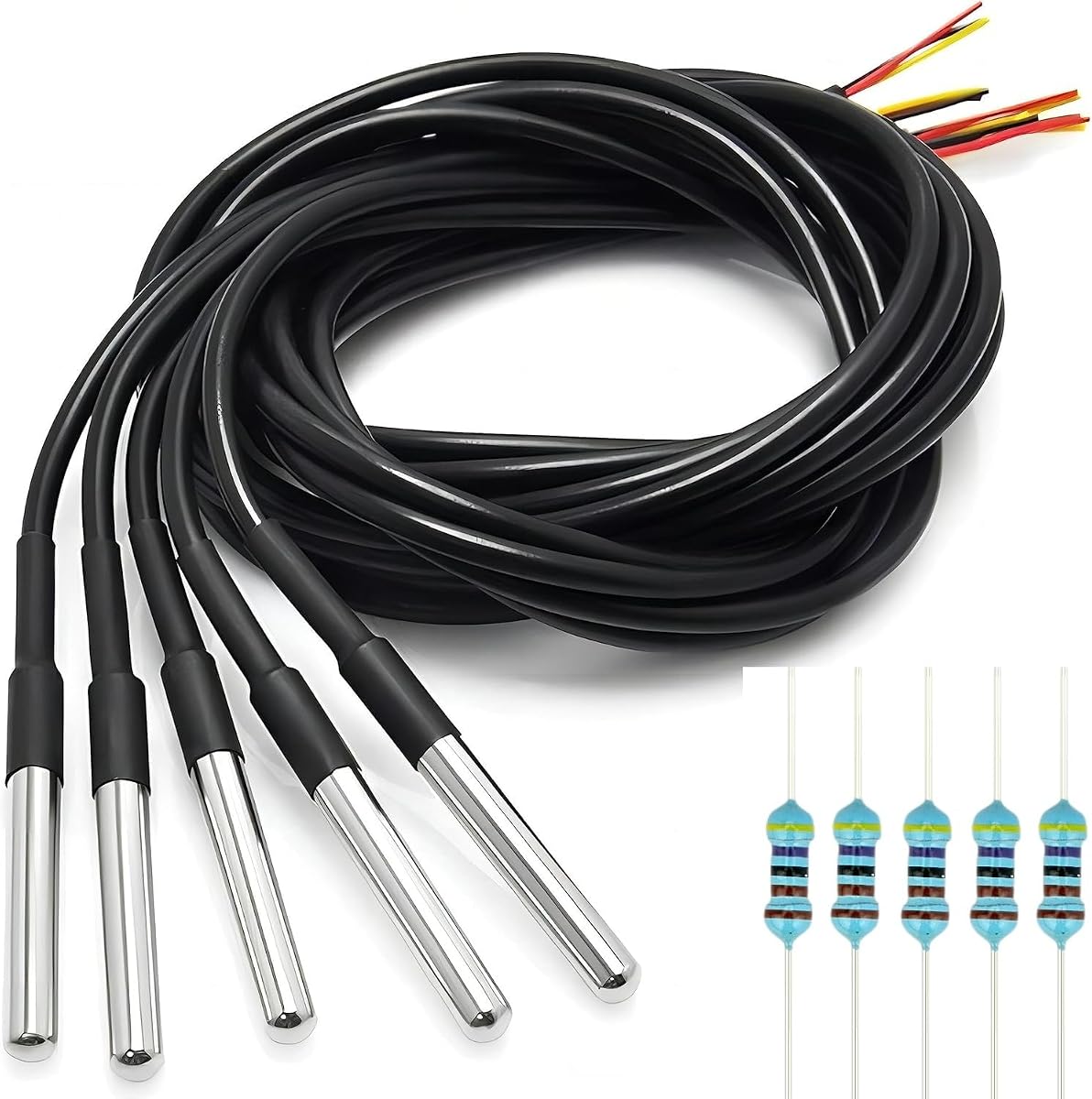
This kit offers a cost-effective solution for those needing multiple waterproof sensors. The DS18B20 probes are rated for high accuracy and wide temperature ranges, suitable for both Arduino and Raspberry Pi. The package includes 4.7K resistors, which are essential for the 1-Wire communication protocol to function correctly.
We may earn a commission when you buy through this link, at no additional cost to you.
The probes are encased in stainless steel, providing excellent protection against moisture. The three-wire setup (VCC, Data, GND) is straightforward to follow. The wide voltage range ensures compatibility with various power supplies. This makes it a versatile option for building multi-point temperature monitoring systems.
One drawback is that it lacks an adapter module, meaning you may need to solder wires directly to the probe terminals or use crimpers. This adds a step to the setup process compared to kits with adapters. However, the included resistors add value and ensure you have what you need for stable data.
If you are setting up a distributed sensor network or need spares for large projects, this kit is highly recommended. It offers excellent value for money. We suggest this for hobbyists building complex monitoring setups who don't mind a little wiring work.
Having the resistors included saves you a trip to the electronics store and ensures you have the right values.
Compatible with both Arduino and Raspberry Pi, making it a flexible choice for different ecosystem users.
We may earn a commission when you buy through this link, at no additional cost to you.
This module provides a straightforward way to measure temperature and humidity with a compact footprint. The digital signal output ensures that your microcontroller receives clean data without noise interference. The included wires make it plug-and-play for many users. It is a reliable option for general indoor environmental monitoring.
We may earn a commission when you buy through this link, at no additional cost to you.
The module is designed for compatibility with Arduino and Raspberry Pi, broadening its appeal. The stable long-term performance ensures that the sensor does not drift significantly over time. The fixing screw hole makes it easy to mount securely inside a project enclosure or on a wall.
While it shares similar limitations to other DHT11 models, such as a limited temperature range, it remains a solid budget option. The pre-attached wires save time during prototyping. The accuracy is sufficient for comfort monitoring but not for scientific experiments.
Ideal for beginners who want a simple module without soldering or complex wiring. It works well for simple weather stations. We recommend this for educational projects or basic smart home devices.
The pre-attached wires allow you to connect directly to your board without additional wiring steps.
The integrated circuit ensures stable readings over time, reducing the need for recalibration.
We may earn a commission when you buy through this link, at no additional cost to you.
With a 4.9-star rating, this kit is highly rated for its completeness and quality. It includes everything you need to start measuring temperature immediately: probes, adapter boards, jumpers, and resistors. The waterproof stainless steel probes ensure durability in wet environments. This makes it an excellent choice for comprehensive kits.
We may earn a commission when you buy through this link, at no additional cost to you.
The color-coded wires simplify connections significantly. The heat shrink tubing provides a clean finish and extra insulation. The adapter board supports the 1-Wire protocol directly. This allows for easy integration with GPIO ports. The wide voltage range adds flexibility to your power design.
The only minor downside is that the cables might be longer than some users need, which can clutter your workspace. However, the quality of the stainless steel and the complete package make up for this. It is designed to be user-friendly for all skill levels.
This is a great all-in-one solution for anyone looking to avoid sourcing individual components. It is perfect for students or hobbyists who value convenience. We highly recommend this for reliable and easy setup.
Everything required for a successful setup is included, saving time and effort.
Color-coded wires and heat shrink tubing make the final build look professional and organized.
We may earn a commission when you buy through this link, at no additional cost to you.
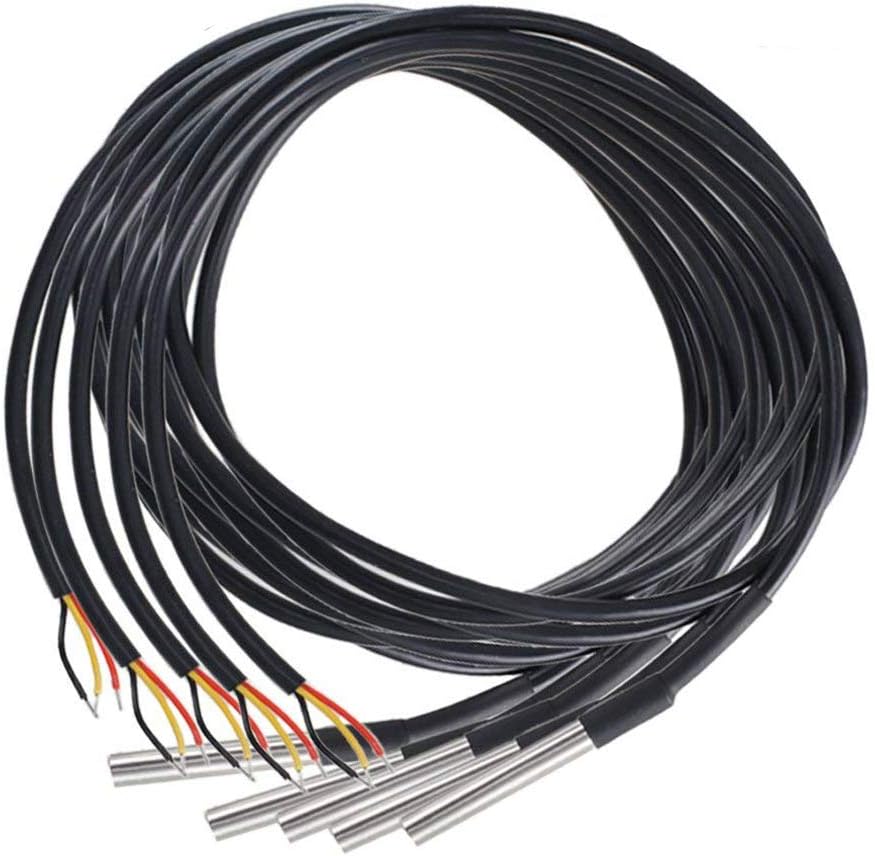
This pack offers five waterproof sensors, providing significant value for large-scale monitoring projects. The 1-meter length ensures you can place sensors far from your controller. The stainless steel waterproof casing protects against moisture damage. This makes it suitable for multiple-zone temperature control systems.
We may earn a commission when you buy through this link, at no additional cost to you.
The single bus interface is efficient for connecting multiple devices without needing many pins. The wide voltage range supports various power options. This flexibility allows for use in diverse applications. The waterproof nature ensures longevity in industrial or outdoor settings.
The lack of adapters means you may need to solder or use breadboard headers. However, the bulk quantity is a huge plus for building multiple units. The performance is consistent with the standard DS18B20 profile.
Best for users who need to monitor temperature in several different locations. It is ideal for agricultural or industrial bulk setups. We recommend this if you need spares and multiple points for your system.
Five units in one package ensure you have replacements and can monitor multiple points simultaneously.
The 1-meter cable allows remote sensing, keeping your electronics in safe, dry zones.
We may earn a commission when you buy through this link, at no additional cost to you.
The DHT22/AM2302 module offers high sensitivity and a wider range than the DHT11. It is an excellent upgrade for projects needing better humidity accuracy. The bidirectional serial data allows for more efficient communication. This makes it suitable for high-quality environmental monitoring applications.
We may earn a commission when you buy through this link, at no additional cost to you.
The module comes with a fixing screw hole for easy mounting. The wide humidity range from 0 to 100% RH ensures it can detect saturation. The digital calibration ensures reliable data over time. This makes it a robust choice for smart agriculture or climate control.
It is slightly more expensive than basic DHT11s but delivers better precision. The pull-up resistor is required but standard. The design is user-friendly and durable. It is a great choice for those needing reliable long-term performance.
Ideal for users who need better accuracy and full humidity coverage. It works well for professional or serious hobbyist applications. We recommend this for precise climate tracking.
The AM2302 chip provides tighter tolerances for both temperature and humidity than entry-level sensors.
Measures up to 100% humidity, making it capable of detecting condensation and saturation.
We may earn a commission when you buy through this link, at no additional cost to you.
This pack of five sensors is a reliable choice for multiple monitoring points. The stainless steel package ensures they survive harsh or wet environments. The 1-meter length allows for flexible placement. This makes it a practical choice for industrial or large-scale setups.
We may earn a commission when you buy through this link, at no additional cost to you.
The 1-Wire protocol supports daisy-chaining. The wide voltage range ensures compatibility with various boards. The readings are consistent and reliable for general use. It provides good value for those needing multiple sensors without high costs.
It requires you to handle the wiring and pull-up resistors yourself. This might be a slight barrier for absolute beginners. However, the durability and quantity make it a great value proposition. The waterproofing protects the electronics effectively.
Best for users building multiple systems or needing replacements. It is ideal for budget-conscious projects requiring robust sensors. We recommend this for anyone needing durable, multiple sensors.
The stainless steel tube protects the sensor from physical damage and corrosion.
Operates on a wide range of voltages, making it adaptable to different power supplies.
We may earn a commission when you buy through this link, at no additional cost to you.
When selecting a temperature sensor, you must consider factors like communication protocol, accuracy, and environmental durability to ensure it fits your project needs.
The communication protocol determines how the sensor connects to your board. I2C and 1-Wire are common for digital sensors. Analog sensors use voltage output which needs an ADC. Understanding your board's available pins and capabilities helps you choose the right type.
For most projects, digital protocols like I2C are easier to manage. 1-Wire is great for saving pins. Always check your board's documentation to ensure compatibility with the sensor's data lines.
Every sensor has a specific range of temperatures it can measure. Some cover only indoor ranges while others handle extreme heat or cold. Ensure the range covers your expected operational conditions to avoid inaccurate readings or damage.
Always check the minimum and maximum limits. If your project involves freezing or boiling temperatures, select a sensor with a wide industrial range to ensure safety and accuracy.
Accuracy refers to how close the reading is to the actual value. Precision is how consistently the sensor repeats the same value. High-precision sensors are vital for scientific or critical industrial applications where small errors matter.
For general hobby projects, standard accuracy is often sufficient. However, for HVAC or medical devices, invest in high-precision models to ensure safety and reliability.
Consider where the sensor will be installed. If it is near water or chemicals, a waterproof or sealed casing is necessary. Plastic sensors might degrade in UV light, so choose metal or specialized coatings for outdoor use.
Waterproof probes are essential for tanks or outdoor weather stations. Stainless steel casing provides extra protection against physical impact and corrosion in harsh environments.
Battery-powered projects require low-power sensors. Some digital modules consume more energy in standby than others. Check the datasheet for current draw to calculate battery life accurately.
Always prioritize low power if you need your device to run for weeks on a single charge. Look for sleep modes or low-power variants if energy is a concern.
Your sensor must operate within the voltage range of your microcontroller. Some need 3.3V while others need 5V. Connecting the wrong voltage can damage the sensor permanently. Always verify the supply requirements before wiring.
If your board is 3.3V, ensure the sensor is compatible. Some modules have voltage regulators on-board, but it is safer to match the sensor's rated voltage directly to avoid issues.
Pre-assembled modules with headers or wires are easier to plug in than raw chips. Soldering may be required for some probes. If you lack soldering skills, choose a module with jumpers or breakout pins.
Modules with adapters and jumpers speed up prototyping. For production or permanent builds, soldering ensures a more robust connection and better longevity.
Software libraries make reading data much easier. Check if popular libraries like Adafruit or Sparkfun support your chosen sensor. Poor library support can lead to difficult debugging and unstable code.
Always check GitHub or the manufacturer's website for documentation. Robust library support ensures you can find examples and community help if you run into coding issues.
To begin, identify the VCC, GND, and Data pins on your sensor module. Connect VCC to your board's 3.3V or 5V pin depending on the sensor's requirement. Connect GND to the board's ground pin to establish a common reference for the circuit.
For digital sensors like DHT11 or DS18B20, connect the data pin to a digital GPIO pin. If using a pull-up resistor, place it between the data and VCC pins as specified in the datasheet. Ensure all connections are secure to prevent noise interference during data read.
After wiring, upload code to read the values and display them on your serial monitor. Check if the values seem reasonable. For long-term use, avoid bending the wires repeatedly and keep the sensor away from direct heat sources to maintain accuracy.
The SHT31 and AHT30 are among the most accurate, offering precision within 0.3 degrees Celsius. They use digital protocols to minimize noise and provide consistent readings suitable for demanding projects.
Yes, many modern sensors like the AHT30 and SHT31 support 3.3V directly. However, always check the datasheet to ensure your specific module works with your microcontroller's voltage level.
Use a protocol like I2C or 1-Wire. I2C allows multiple sensors on two wires with different addresses. 1-Wire allows daisy-chaining multiple probes on a single data line.
Unstable readings often result from loose connections or missing pull-up resistors. Ensure your wiring is secure and you have the correct resistor values. Noise from power supplies can also cause fluctuations.
DS18B20 sensors are commonly available in waterproof stainless steel packages. They are ideal for underwater or outdoor use where moisture protection is required.
Open your Arduino IDE, go to Sketch > Include Library > Manage Libraries. Search for the sensor name like DHT or DS18B20 and click Install. This adds the necessary code to read your sensor.
We have explored a wide range of sensors from basic DHT11 modules to precise SHT31 sensors. Each option offers unique benefits depending on your specific needs. The HiLetgo DHT11 is great for beginners while the DROK kit offers the most convenience for waterproof use.
Prioritize accuracy and durability based on where you plan to place the sensor. If you need precise data, choose an I2C model. If you need a waterproof option, the DS18B20 kits are your best bet. Always match the voltage and protocol to your board.
Remember that availability and details may vary. Check the product page for the latest information before you buy. With the right sensor, your projects will be more responsive and reliable.