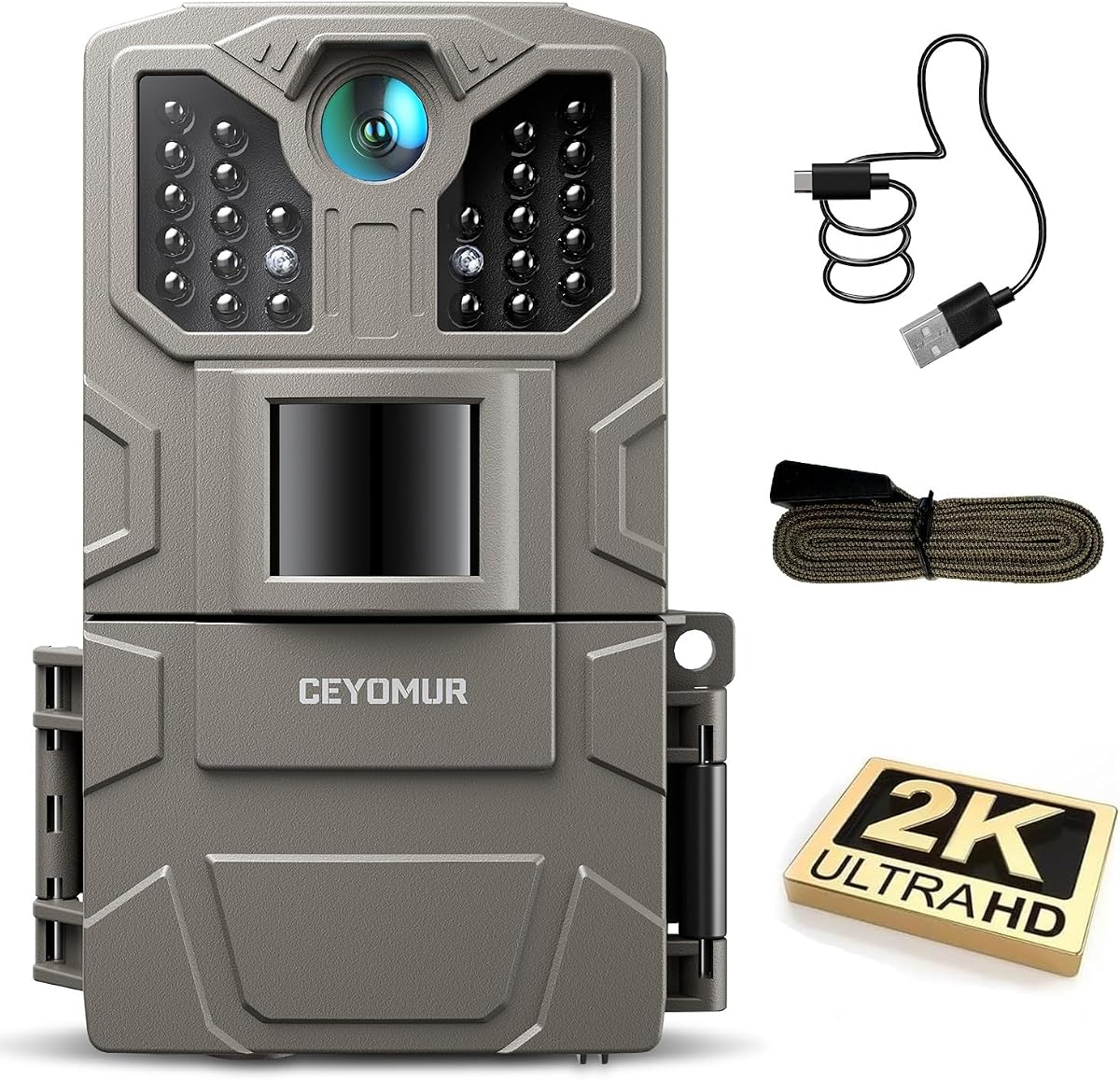
CEYOMUR Trail Camera
4.0Editor score
36MP Photos and 2K Video
850nm Infrared Night Vision
IP66 Waterproof Rating
Discover the top battery life trail camera options for 2026. Our expert guide compares features, power efficiency, and performance to help you choose the best
Trail cameras are essential tools for wildlife monitoring, security, and hunting. However, battery life remains a critical factor for long-term deployment in remote locations where frequent access is difficult or impossible for users.
We analyzed ten top-rated models focusing on power efficiency, solar compatibility, and overall durability. This list covers non-cellular and cellular options, ensuring you find a device that matches your specific monitoring needs and budget constraints effectively.
Each pick highlights unique strengths such as trigger speed, night vision quality, and battery management systems. Please note that prices change frequently, so verify current costs before purchasing to ensure you get the best value available today.
4.0Editor score

4.2Editor score

4.3Editor score
This side-by-side comparison highlights key specifications for all ten selected models to help you make an informed decision based on resolution, connectivity, and power systems.


The WOSPORTS Trail Camera stands out for its versatile power options and high resolution. With a rating of 4.3 stars, it offers a robust solution for users needing long battery life through solar or rechargeable battery support.
We may earn a commission when you buy through this link, at no additional cost to you.
Its ability to capture 64MP photos and 4K video ensures detailed footage. The 0.2S trigger speed prevents missed moments, while the 120-degree wide-angle lens covers large areas effectively during the day or night.
Trade-offs include the lack of cellular connectivity for remote viewing. However, the option to use solar panels or rechargeable batteries offsets this limitation for those prioritizing extended deployment without frequent battery changes.
This camera is ideal for wildlife monitors and home security users who value image quality and flexible power management. It delivers reliable performance in various outdoor conditions.
Supports 8xAA batteries, rechargeable lithium, or solar panels for extended monitoring.
Captures sharp 64MP photos and smooth 4K videos for clear wildlife observation.
We may earn a commission when you buy through this link, at no additional cost to you.
The Moultrie Edge 3 Cellular delivers advanced connectivity for remote monitoring. Rated 4.3 stars, it combines cellular power with rechargeable battery packs to maintain uptime while you access data instantly without visiting the site.
We may earn a commission when you buy through this link, at no additional cost to you.
Key strengths include AI buck detection and nationwide 4-carrier auto-connect. These features reduce false alerts and ensure reliable image delivery even in remote hunting properties without manual SIM card setup.
Trade-offs involve subscription fees for cellular service which can add up. However, the convenience of real-time alerts and remote feeder control justifies the cost for serious hunters and land managers.
This model suits users who need immediate access to wildlife data. Its robust feature set ensures you stay connected to your property regardless of location.
AI identifies bucks and delivers high-resolution photos instantly via cellular network.
Adjust settings and control feeders remotely through the Moultrie app.
We may earn a commission when you buy through this link, at no additional cost to you.
The MAXDONE Solar Trail Camera excels in sustainable power management. With a 4.2 rating, its 6000mAh rechargeable battery paired with a high-efficiency solar panel provides uninterrupted power for year-round monitoring without disposable batteries.
We may earn a commission when you buy through this link, at no additional cost to you.
Its 64MP photo and 4K video quality ensure clear details. The 0.1s trigger speed captures fast movement instantly while WiFi and Bluetooth apps allow local data viewing without subscriptions or cloud fees.
Trade-offs include limited WiFi range for initial setup. While cellular connectivity is absent, the solar capability ensures you do not miss footage even in harsh weather conditions due to power loss.
This camera is perfect for outdoor enthusiasts and security users wanting eco-friendly options. Its durable design and low maintenance make it a strong choice for long-term deployment.
High-efficiency solar charging combined with 6000mAh battery offers maintenance-free power.
Free app allows direct photo viewing and downloading without SD card removal.
We may earn a commission when you buy through this link, at no additional cost to you.
The Meidase P70 delivers high resolution and fast performance for hunting. With a 4.4 rating, it captures crystal-clear 64MP photos and 1296p video while maintaining stealth with bright 100ft no-glow night vision.
We may earn a commission when you buy through this link, at no additional cost to you.
Its 0.1s trigger speed ensures you capture fast wildlife. H.264 video compression reduces file sizes for faster downloads, while the 2.4 color display makes reviewing footage on-site intuitive and quick.
Trade-offs include lack of cellular connectivity requiring physical retrieval. However, its solar-ready design lets you pair with a solar panel for extended battery life if you plan long deployments.
This model suits hunters needing detailed night images without spooking animals. Its fast trigger and efficient compression make it a reliable choice for capturing elusive game.
Bright 100ft no-glow LEDs deliver sharp footage without disturbing wildlife.
H.264 tech compresses videos for quicker downloads and easier storage.
We may earn a commission when you buy through this link, at no additional cost to you.
The WOSPORTS Mini Trail Camera offers a compact solution for discreet monitoring. Rated 4.2 stars, its small 4.25×4.21×3.43 inch body blends well into forests making it hard for wildlife to detect.
We may earn a commission when you buy through this link, at no additional cost to you.
Key strengths include lightweight design and simple setup. Powered by 4 AA batteries, it provides adequate standby time for smaller coverage areas where frequent battery changes are acceptable.
Trade-offs include lower 30MP resolution compared to larger models. However, its portability and low power consumption make it ideal for temporary projects or tight budget constraints.
This camera is best for casual observers or garden security. Its small size ensures you can monitor multiple spots without carrying heavy equipment into the field.
Compact camouflage body blends naturally into outdoor environments.
Lightweight design supports longer standby time with standard AA batteries.
We may earn a commission when you buy through this link, at no additional cost to you.
The GardePro E5S Camera prioritizes speed and reliability. With a 4.4 rating, its three PIR sensors enable a lightning-fast 0.1s trigger speed ensuring you capture moving deer without blur.
We may earn a commission when you buy through this link, at no additional cost to you.
Its non-cellular design minimizes power use for fewer battery changes. The 64MP photo and 1296P video quality are sharp, and its IP66 rating ensures ruggedness against rain and dust.
Trade-offs include lack of cellular connectivity for remote checks. However, the energy-efficient design extends battery life significantly for those willing to visit sites periodically.
This model is ideal for hunters needing consistent capture rates. Its low-power operation and fast trigger make it a dependable tool for tracking wildlife movements.
Three PIR sensors enable 0.1s trigger speed for capturing fast wildlife.
Non-Cellular operation reduces power use and extends battery life.
We may earn a commission when you buy through this link, at no additional cost to you.
The CEYOMUR Trail Camera is designed for beginners. Rated 4.0 stars, it features simple controls and a solid brown housing that blends into surroundings without requiring technical knowledge.
We may earn a commission when you buy through this link, at no additional cost to you.
Key strengths include an integrated side design for easy setup. The 850nm night vision captures brighter images than standard 940nm options, ensuring details in complete darkness without confusion.
Trade-offs include basic feature sets lacking advanced connectivity. However, its affordable price and reliability make it a perfect entry point for first-time trail camera users.
This camera suits casual users wanting a no-frills option. Its easy setup and durable build ensure you can start monitoring quickly without complex configurations.
Integrated design places lens and controls on one side for easier use.
850nm LEDs produce sharper nighttime images with less noise.
We may earn a commission when you buy through this link, at no additional cost to you.
The WOSPORTS Mini 2 Pack kit provides broad coverage for the price. Rated 4.2 stars, it includes two cameras and 16GB SD cards allowing immediate deployment across multiple locations without buying accessories.
We may earn a commission when you buy through this link, at no additional cost to you.
Key strengths include compact design and low power consumption. Each camera uses 4 AA batteries offering reasonable standby times for temporary monitoring setups in various outdoor environments.
Trade-offs involve lower 30MP resolution compared to single high-end units. However, the dual-unit value ensures you capture more activity across a larger area effectively.
This kit suits property owners monitoring large land. Its cost-effective design helps track movements across trails without needing expensive high-end units for every spot.
Monitor multiple locations at once with included kit.
Includes SD cards for immediate installation and capture.
We may earn a commission when you buy through this link, at no additional cost to you.
The WOSODA Mini Trail Camera offers a comprehensive bundle. Rated 4.3 stars, it includes four cameras with 16GB SD cards and batteries enabling immediate setup across multiple points without extra purchases.
We may earn a commission when you buy through this link, at no additional cost to you.
Key strengths include stealth camouflage and fast trigger. The 0.3s trigger speed ensures details are captured while the compact design blends into natural surroundings without disturbing wildlife.
Trade-offs require buying 16 AA batteries for full kit. However, this investment provides extensive coverage allowing you to monitor trails from various angles for a single price.
This bundle suits landowners needing wide area surveillance. Its ready-to-go package ensures you can start tracking wildlife immediately across large properties.
Includes four cameras with batteries and SD cards for immediate use.
Camouflage helps cameras blend into natural environments.
We may earn a commission when you buy through this link, at no additional cost to you.
The GardePro E5S 2-Pack delivers high resolution across two units. Rated 4.4 stars, it provides 64MP photos and 1296P video ensuring sharp details for both cameras included in the bundle.
We may earn a commission when you buy through this link, at no additional cost to you.
Key strengths include 0.1s trigger speed and solar compatibility. Its rugged IP66 rating withstands harsh weather while flexible recording modes and storage support up to 512GB SD cards.
Trade-offs include higher initial cost and no batteries. However, the dual high-res setup ensures consistent capture of wildlife movement for serious users monitoring large properties.
This bundle suits serious hunters needing reliable data. Its high resolution and weather resistance make it a top choice for extended multi-camera deployment.
Both cameras capture 64MP photos and 1296P video.
Bundle allows monitoring multiple areas with consistent quality.
We may earn a commission when you buy through this link, at no additional cost to you.
Choosing the right battery life trail camera requires balancing power needs with resolution and connectivity. This guide outlines key factors to consider for long-term deployments.
Trail cameras typically use standard AA lithium or alkaline batteries. Lithium batteries offer better cold weather performance and longevity compared to alkalines.
Prioritize lithium batteries for cold climates to ensure consistent operation during winter months.
Solar panels provide continuous power reducing the need for battery replacements. Check if your chosen model supports external solar inputs.
Solar compatibility extends deployment time significantly for remote locations.
Cellular cameras transmit data remotely but consume more power due to transmission cycles. Non-cellular models rely on physical retrieval which preserves battery life.
Choose cellular only if remote access is critical to your workflow.
Fast trigger speeds ensure you capture fleeting moments. Slower triggers may miss fast-moving wildlife causing unnecessary battery drain from missed shots.
Look for trigger speeds under 0.3 seconds for reliable wildlife capture.
Higher resolutions like 64MP provide more detail but require more processing power. Ensure your battery or solar source can handle high-res demands.
Match resolution needs to your monitoring goals to conserve power.
Large SD cards store more photos reducing retrieval trips. Loop recording prevents full memory issues ensuring continuous operation.
Select cards supporting loop recording to maintain steady battery usage.
IP66 rating protects against rain and dust ensuring internal electronics survive storms. Poor seals lead to corrosion draining batteries faster.
Choose waterproof models to protect internal components from damage.
Wide detection ranges reduce battery waste from unnecessary activation. Adjust zones to focus on target paths ensuring efficient energy usage.
Narrow detection zones conserve battery by avoiding false triggers.
Install batteries correctly ensuring polarity matches device requirements. Use lithium batteries for better performance in temperature fluctuations.
Position cameras 3 to 4 feet high angled slightly down to avoid tree branches. Ensure clear line of sight to the path you wish to monitor.
Regularly clean lenses with soft cloth to remove dust or condensation. This prevents blurry images and ensures sensors detect motion accurately.
Battery life varies based on activity and model. High-traffic areas may drain batteries in a few weeks while low-traffic zones can last months with lithium options.
Solar panels still generate power in winter though less efficiently due to shorter days. Ensure they face south with minimal obstruction for best results.
Lithium batteries perform better in cold weather and last longer overall. They maintain consistent voltage ensuring stable camera operation.
Yes if the camera is weather-rated like IP66. Check batteries periodically to ensure continuous operation throughout the year.
Most modern cameras support 256GB or 512GB cards. Larger cards mean fewer visits to retrieve footage extending battery life.
Adjust sensitivity settings and detection zones to focus on specific paths. Avoid pointing cameras at swaying trees that cause false motion alerts.
We highlighted top picks like the MAXDONE Solar for power efficiency and Moultrie for connectivity. Each offers unique strengths depending on your tracking needs.
Prioritize solar or lithium options if you monitor remote areas frequently. These choices save time and maintain data continuity without constant site visits.
Always check current prices and stock availability before purchasing. Technology updates may introduce new models with improved efficiency in the near future.