
STEM Electric Circuit Kit, Electricity Science Project Light Bulb Experiments for Kids Teens
4.5Editor score
8 engaging circuit experiments
Detailed guided learning book
Ideal for ages 8 and up
This guide compares the top ten electricity learning kits for students and educators, evaluating features, project counts, and educational value to help you
Electricity learning kits provide hands-on ways for students to understand circuits, magnetism, and energy through guided projects. These educational tools transform abstract physics concepts into tangible experiences that spark curiosity and deepen scientific understanding in classrooms and homes.
We compared ten top-rated kits based on project variety, component quality, safety features, and instructional clarity. Our analysis focuses on how well each kit supports STEM education, encourages problem-solving, and adapts to different age groups from elementary to high school levels.
Each pick highlights unique strengths like project counts, component sets, or specialized experiments. Prices and availability change frequently, so always verify current details before purchasing. Our goal is to help you choose a kit that fits your learning goals and budget effectively.
4.5Editor score

4.7Editor score

4.5Editor score
The following table provides a side-by-side comparison of all ten kits, highlighting key specifications such as project counts, included components, target age ranges, and special features to help you quickly identify the best fit for your needs.



This National Geographic kit stands out as a top choice with over 120 electrical projects designed for kids to explore electricity. It holds a strong 4.7 rating from users who appreciate its educational depth and engaging features that transform learning into fun.
We may earn a commission when you buy through this link, at no additional cost to you.
The kit offers diverse projects ranging from light shows to sound systems and copters, providing endless opportunities for creative exploration. Components connect without tools using secure snap wires, ensuring safety and ease of use for young learners at home or school.
While the project count is impressive, younger children might find some setups challenging without adult supervision. Additionally, batteries are required for operation but not included in the box, which is a common oversight to note before starting experiments.
This kit is ideal for families seeking a comprehensive STEM tool that fosters imagination and technical skills. We recommend it for parents and educators looking for a high-quality resource that balances fun with serious educational value.
The variety of projects like keyboards and copters keeps children motivated to learn complex electrical concepts through play.
Designed with kid-friendly components and snap wires, this kit ensures safe handling while simplifying the setup process.
We may earn a commission when you buy through this link, at no additional cost to you.
This STEM kit offers an excellent entry point for younger learners interested in electricity through eight core circuit experiments. Its 4.5 rating reflects satisfaction with its straightforward approach to teaching series, parallel, and fruit battery concepts effectively.
We may earn a commission when you buy through this link, at no additional cost to you.
The included circuit book provides clear step-by-step instructions that encourage critical thinking and problem-solving skills. Kids can follow along to light bulbs using various methods, making abstract ideas like conductivity and energy tangible and fun.
While it covers essential basics, the limited experiment count might not sustain interest long-term compared to larger sets. Parents should ensure they have AA batteries on hand as these are necessary but not provided with the kit.
We recommend this kit for those seeking a cost-effective STEM tool for introducing electrical engineering fundamentals. It suits parents and teachers wanting a simple, reliable resource to spark curiosity without a significant financial investment.
The detailed circuit book ensures kids understand each step, fostering confidence and independent learning skills.
Focuses on core ideas like series and parallel circuits which form the basis for more advanced study.
We may earn a commission when you buy through this link, at no additional cost to you.
This EUDAX kit delivers a premium experience for high school students with a robust set of over 70 items for electricity and magnetism. Its 4.5 rating highlights its effectiveness in teaching complex concepts through structured, hands-on exploration.
We may earn a commission when you buy through this link, at no additional cost to you.
The full-color manuals provide detailed explanations that help students understand the why behind each experiment. Projects include measuring unknown resistors and investigating magnetic force, offering a curriculum-aligned approach that supports classroom learning.
The breadth of components and advanced topics may be overwhelming for beginners or younger kids. Additionally, users must supply three AA batteries to power the experiments, adding a minor preparation step before use.
We recommend this kit for educators and students serious about mastering electrical principles. It serves as an ideal supplement for physics classes, offering depth and rigor that standard kits often lack.
The manuals align with high school physics concepts, ensuring the experiments support academic learning goals.
Includes complex projects like Ohm's law that challenge students to apply mathematical and scientific reasoning.
We may earn a commission when you buy through this link, at no additional cost to you.
The Mysterystone kit provides a rich array of 50 experiments focusing on both electricity and magnetism. With a 4.4 rating, it is praised for offering unique items that let students explore beyond standard circuit setups.
We may earn a commission when you buy through this link, at no additional cost to you.
Features like a magnetic switch and light control LED introduce advanced topics in an accessible way. The storage case ensures all 55 items stay organized, making it convenient for home or school use without losing parts.
Some users note that the components require careful handling during assembly to avoid damage. It is best suited for older children or students with some prior experience to fully appreciate the unique elements.
We recommend this kit for those wanting to delve deeper into electronics with variety. It is an excellent choice for curious learners eager to experiment with specialized parts and detailed guides.
Special items like magnetic switches offer insights into real-world applications of electromagnetism.
The solid case keeps all parts safe and organized, reducing frustration during setup and cleanup.
We may earn a commission when you buy through this link, at no additional cost to you.
This Sntieecr kit specializes in motor experiments, providing a complete set for building circuits that drive motion. Its 4.2 rating reflects its value for students interested in mechanical applications of electrical energy.
We may earn a commission when you buy through this link, at no additional cost to you.
The kit includes two motors, various propellers, and a buzzer, allowing diverse configurations to test speed and direction. Clear instructions help users assemble series and parallel circuits safely with the included clips and holders.
Users advise monitoring voltage carefully as short circuits can generate heat quickly. While effective for motors, the component count is lower than comprehensive sets, limiting the range of possible experiments.
We recommend this kit for students focusing on mechanics and simple machines. It is a practical tool for learning how electricity drives motion in real-world engineering scenarios.
Ideal for kids interested in how motors work, offering tangible results through propellers and fans.
Adhering to voltage limits ensures safety and prevents overheating during extended use.
We may earn a commission when you buy through this link, at no additional cost to you.
This Teenii kit offers a comprehensive set of 50 pieces for exploring electricity and magnetism. With a 4.4 rating, it is recognized for its focus on family activities that foster observation and critical thinking skills.
We may earn a commission when you buy through this link, at no additional cost to you.
Included measuring tools like ammeters and voltmeters allow kids to quantify their experiments, bridging theory and practice. The 18 experiments range from fruit batteries to electric bells, providing a balanced learning experience.
The manual is informative but less colorful than some competitors, which may affect engagement for younger children. Users should prepare AA batteries as these are essential but not included in the package.
We recommend this kit for parents seeking a collaborative learning tool. Its inclusion of measurement devices makes it a strong choice for students progressing beyond basic circuits.
Including meters helps students understand data collection and scientific measurement practices.
Designed for parent-child discovery, it encourages communication and teamwork during experiments.
We may earn a commission when you buy through this link, at no additional cost to you.
This Physics Labs kit is tailored for high school students with a strong focus on electromagnetism and circuit theory. Its 4.5 rating indicates high satisfaction among users seeking deeper scientific understanding.
We may earn a commission when you buy through this link, at no additional cost to you.
The kit includes specialized items like a magnetically controlled switch and a sensitive ammeter, enabling precise experimentation. The manual not only guides steps but explains the principles behind each setup effectively.
Users need to prepare three AA batteries to power the experiments, adding a minor setup step. The complex nature may not suit elementary learners, making it best for older students or advanced beginners.
We recommend this kit for students preparing for advanced science courses. Its rigorous content ensures thorough coverage of topics like Ohm's law and magnetic force investigations.
The sensitive ammeter allows accurate current readings, vital for serious physics study.
The sturdy double-layer box keeps parts secure and easy to transport between school and home.
We may earn a commission when you buy through this link, at no additional cost to you.
This EUDAX Basic Kit is an affordable entry point for students in grades 7 to 9 learning circuit basics. Its 4.6 rating reflects user satisfaction with its simplicity and clarity for reinforcing classroom knowledge.
We may earn a commission when you buy through this link, at no additional cost to you.
English instructions make assembly straightforward for students and parents. The kit focuses on series and parallel circuits, helping learners build a solid foundation before moving to more complex projects.
The component selection is basic, which may limit advanced exploration. Also, users must supply two AA batteries for the experiments to function, which is a common consideration for educators.
We recommend this kit for schools or families on a budget seeking fundamental training. It effectively supports basic STEM education without overwhelming young learners with complexity.
Designed to solidify concepts taught in school, offering practical application of theoretical knowledge.
Clear English instructions and limited parts make it easy for beginners to succeed quickly.
We may earn a commission when you buy through this link, at no additional cost to you.
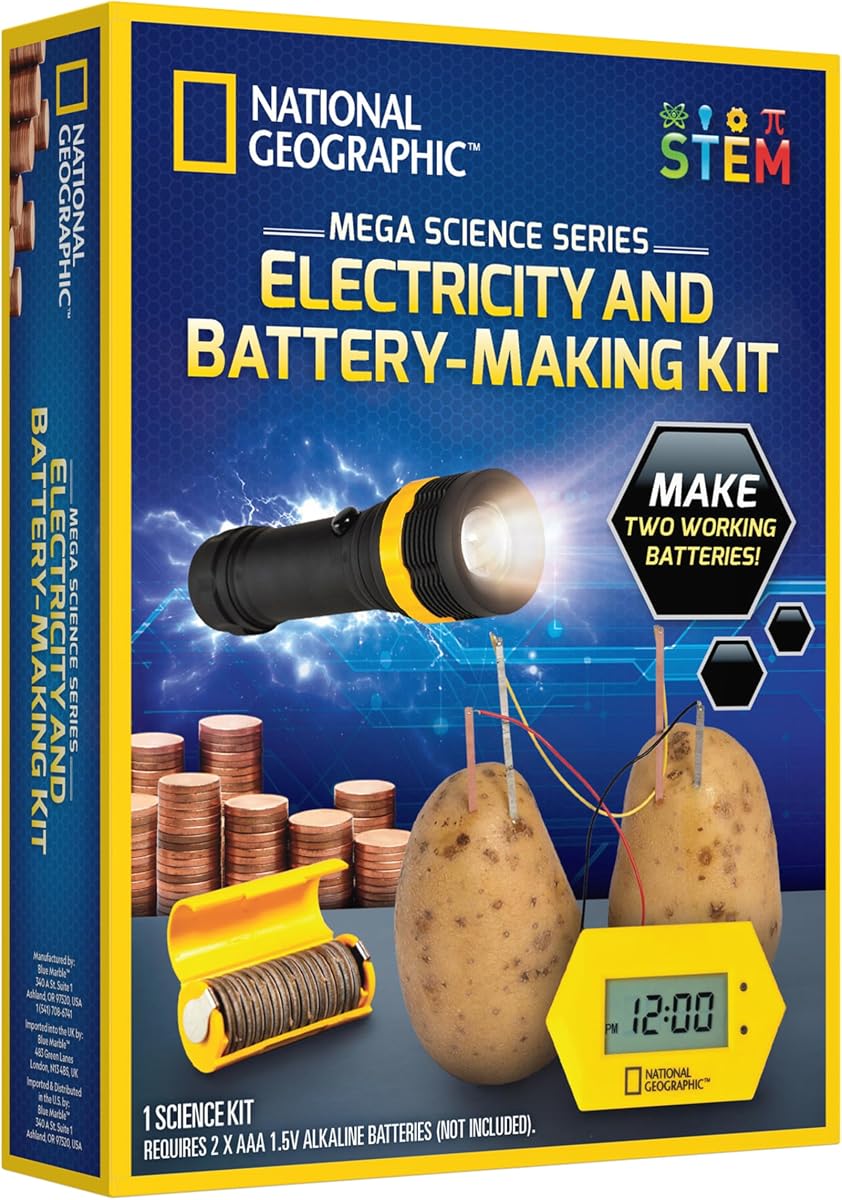
This National Geographic kit offers a focused experience on battery generation with two distinct projects. With a 4.5 rating, it is celebrated for its hands-on approach to teaching energy storage in a fun way.
We may earn a commission when you buy through this link, at no additional cost to you.
The potato clock and coin flashlight experiments make abstract energy concepts tangible. A voltmeter allows kids to see the results of their efforts, reinforcing the science behind electricity generation.
While engaging, the kit is limited to two main projects, which may not provide enough variety for long-term use. Fresh potatoes are required for the clock experiment, adding a perishable component.
We recommend this kit for a focused introduction to battery science. It is ideal as a complement to broader kits or for specific classroom demonstrations on energy.
Building a battery from everyday items like potatoes makes the science of energy accessible and exciting.
Including a voltmeter adds a layer of accuracy and data collection to the experiments.
We may earn a commission when you buy through this link, at no additional cost to you.
This EUDAX Upgrade Kit builds on basic models with additional components and project variety. Its 4.4 rating highlights its value for students seeking to explore more complex setups like traffic lights.
We may earn a commission when you buy through this link, at no additional cost to you.
The manual includes color illustrations and principles that aid in understanding electrical logic. Projects like wind power cars and hand crank generators introduce renewable energy concepts effectively.
Users need to supply two AA batteries to operate the experiments. The complexity may be challenging for younger children, so it is best suited for older students or advanced beginners.
We recommend this kit for educators wanting a flexible learning tool. It balances affordability with advanced features, making it a strong candidate for middle and high school use.
Projects like traffic lights and wind cars introduce logic gates and renewable energy concepts.
Color manuals provide clearer guidance than standard text, aiding comprehension of complex setups.
We may earn a commission when you buy through this link, at no additional cost to you.
Selecting the right electricity learning kit depends on age, budget, and educational goals. This guide outlines the key factors to consider to ensure you choose a kit that supports effective STEM learning.
Ensure the kit matches the learner's age and prior knowledge. Younger students benefit from simple snap-together components and guided projects, while older students can handle complex wiring and measurement tools.
Always check the recommended age range to guarantee safety and appropriate difficulty.
Look for kits with diverse projects to maintain interest. A variety of experiments ranging from basic circuits to magnetism or motors offers broader exposure to electrical concepts.
Kits with 50+ projects provide better long-term value for curious learners.
Durable components reduce frustration during assembly. Sturdy wires, secure connectors, and high-quality motors ensure reliable experiments that withstand repeated use.
Check reviews for mentions of breakage or fragile parts before purchasing.
Clear instructions are vital for self-guided learning. Manuals with step-by-step diagrams or video QR codes help students understand both the how and why of experiments.
Prioritize kits that explain scientific principles alongside procedures.
Consider whether tools or batteries are included. Kits with voltmeters or ammeters add educational value, while those needing separate batteries should be budgeted for upfront.
Inclusive kits often offer better value by reducing hidden costs.
A good storage case keeps parts organized and safe. Look for kits with labeled compartments or sturdy boxes to prevent lost pieces and easy transport.
Organization is key for repeat use and classroom environments.
Safety should never be compromised. Choose kits with kid-friendly components, low-voltage limits, and clear warnings to prevent overheating or shocks.
Supervision is always recommended during experiments.
Align the kit with curriculum goals if possible. Kits that cover topics like Ohm's law or electromagnetism directly support classroom learning and homework.
Check if the content matches your educational needs.
Always read the manual completely before starting any experiment to understand safety warnings and assembly steps. Follow the suggested order to build foundational knowledge before attempting complex projects.
Store components in their designated boxes after each session to prevent loss. Keep wires untangled and inspect them regularly for wear to ensure reliable connections.
Avoid mixing old and new batteries as this can cause overheating. If components get hot, disconnect them immediately and allow them to cool before resuming work.
Most kits require batteries but not all include them. Check the product description to see if AA or AAA batteries are provided or must be purchased separately.
Many kits are designed for beginners with simple instructions. Look for labels like 'Basic Kit' or 'Introductory' if you are new to electronics.
Kits for ages 8+ often allow independent use, but adult supervision is recommended for younger children. Always review safety instructions before starting.
Yes, most components are reusable if handled carefully. Store them properly to ensure they can be used for multiple projects over time.
Contact the manufacturer or seller immediately to report missing parts. Most reputable brands offer replacements or support for defective products.
Some kits include voltmeters, but you can buy separate ones. Always ensure any external tools are compatible with the kit's voltage range.
Many kits cover both electricity and magnetism. Look for specific mentions of magnetic experiments if you want to study both topics.
Check the manual to confirm battery types. Some kits support rechargeable batteries while others recommend standard alkaline cells for safety.
Our top three picks—the National Geographic kit, the STEM Electric Kit, and the EUDAX Premium—offer excellent options for different ages and budgets. Each balances educational value with engaging features to make learning electricity fun.
When choosing, consider the child's age and your goals. A basic kit works for younger students, while premium options support deeper study in high school physics and engineering.
Remember that prices and availability change frequently. Always verify current offers and ensure batteries are included or budgeted for before you start learning.