
LEKATO Looper Guitar Pedal
4.4Editor score
40 minutes total record time
Built-in tuner function
USB import and export
This guide compares the top live looper pedals for musicians to help you find the best device for looping, layering, and live performance needs.
Finding the right live looper pedal can transform how you create and perform music. Whether you are a solo artist or part of a band, these devices allow you to layer sounds in real time. The best options offer reliable recording, intuitive controls, and high-quality audio to match your creative vision.
We compared ten leading looper pedals based on features like recording time, memory slots, and connectivity. Our analysis focuses on ease of use, audio fidelity, and durability for stage or studio settings. Each product brings unique strengths for guitarists, bassists, and keyboard players looking to expand their sound.
Each pick below highlights key specifications, pros, and cons to help you decide. You will see how each pedal handles overdubbing, loops, and effects. Please note that prices and availability may change, so check the latest details before making your final choice.
4.4Editor score

4.7Editor score
4.0Editor score
This side-by-side comparison outlines the core capabilities of each looper pedal. Look for recording capacity, memory options, and special features like drum machines or MIDI control to find the right fit for your setup.


The BOSS RC-1 Loop Station is a highly rated choice for musicians new to looping. It offers a straightforward interface that lets you record, overdub, and undo loops with a single footswitch. Its solid build and reliable performance make it a favorite for practice and small gigs.
We may earn a commission when you buy through this link, at no additional cost to you.
This pedal supports stereo inputs and outputs, allowing for rich audio textures. You can layer phrases for up to 12 minutes and the loop indicator clearly shows whether you are recording or playing. The memory retention feature ensures your loops stay saved even when power is cut.
While it lacks advanced memory slots or USB transfer, the simplicity is its strength. You won't get lost in menus during a performance. The five-year warranty adds peace of mind for users who want a dependable tool without extra complexity.
If you want a no-fuss looper to start building layers, the RC-1 is a strong option. It works well with guitar, bass, or keyboard. Check current availability and pricing to see if it fits your budget and stage needs today.
The visual indicator shows Rec, Overdub, and Play modes so you never lose your place during a live set.
Stereo inputs and outputs let you connect to mixing consoles or amps for a wider sound stage.
We may earn a commission when you buy through this link, at no additional cost to you.
The LEKATO Looper Guitar Pedal delivers impressive features for its price range. It provides 40 minutes of total recording time across 9 loops, which is plenty for most rehearsal or gig scenarios. Users appreciate the lossless audio quality and the convenience of a built-in tuner.
We may earn a commission when you buy through this link, at no additional cost to you.
Its 48K/24bit sampling rate ensures uncompressed sound that retains detail. You can import and export WAV files via USB without needing extra drivers. The simple one-button design handles record, stop, and undo actions through different foot commands, keeping your workflow smooth.
While it does not offer deep memory management like premium models, it covers the basics well. The visual time indicator helps you track loop length. Some users may find the lack of a screen limiting for complex editing, but for straight looping it is effective.
This pedal suits budget-conscious players who need reliable looping and tuning in one unit. It is compact enough for most boards and includes a power supply in some packages. Verify the latest specs before buying to ensure it meets your specific setup requirements.
Lossless 48K/24bit sampling keeps your loops sounding clear and professional without compression artifacts.
Import and export WAV files easily to a PC for backup or further editing without extra software.
We may earn a commission when you buy through this link, at no additional cost to you.
The NUX Loop Core Stereo stands out with six hours of recording time and a bright HD color LCD screen. It offers 99 memory slots and 50 rhythm patterns, making it suitable for composers and performers who need to store many phrases. MIDI control adds flexibility for remote operation.
We may earn a commission when you buy through this link, at no additional cost to you.
You can adjust nearly every parameter via external MIDI commands, which is rare at this price. The customizable boot-up picture lets you personalize the interface. Its stereo audio handling ensures wide soundscapes when layering instruments or effects.
While the feature set is powerful, it may take time to master. Users need to navigate menus to access deeper functions. The larger footprint and cost might be steep for casual players, but professionals will value the depth of control.
Consider this pedal if you plan to build complex loops or integrate with a full MIDI setup. It balances advanced features with a user-friendly screen. Check current pricing and availability to see if it fits your current stage or studio needs.
A large high-definition display makes editing parameters and checking loop status clear even in dark stages.
External MIDI commands let you control start, stop, and tempo without stepping on the pedal directly.
We may earn a commission when you buy through this link, at no additional cost to you.
The TC Electronic DITTO 2 is designed for musicians who want looping without complexity. It features a single button for all operations, making it easy to grab and go. Its true bypass and analog-dry-through ensure your tone stays pure when the loop is off.
We may earn a commission when you buy through this link, at no additional cost to you.
While it lacks memory or USB, it excels at quick recording during shows. You can overdub freely and undo mistakes with a tap. The compact size fits on crowded pedalboards, and the brand reputation suggests solid durability over time.
This unit may feel too basic if you need to save loops or manage multiple phrases. It is ideal for live artists who build a song from scratch each night. If you prefer minimal gear, it delivers exactly that without extra weight.
Check if this fits your style before buying, as it does not store loops beyond the current session. It pairs well with other effects for a streamlined signal chain. Verify current stock and details to confirm it suits your performance needs.
True bypass ensures your guitar tone remains untouched when the looper is disengaged.
Record, overdub, and stop are all handled by one footswitch for quick and easy control.
We may earn a commission when you buy through this link, at no additional cost to you.
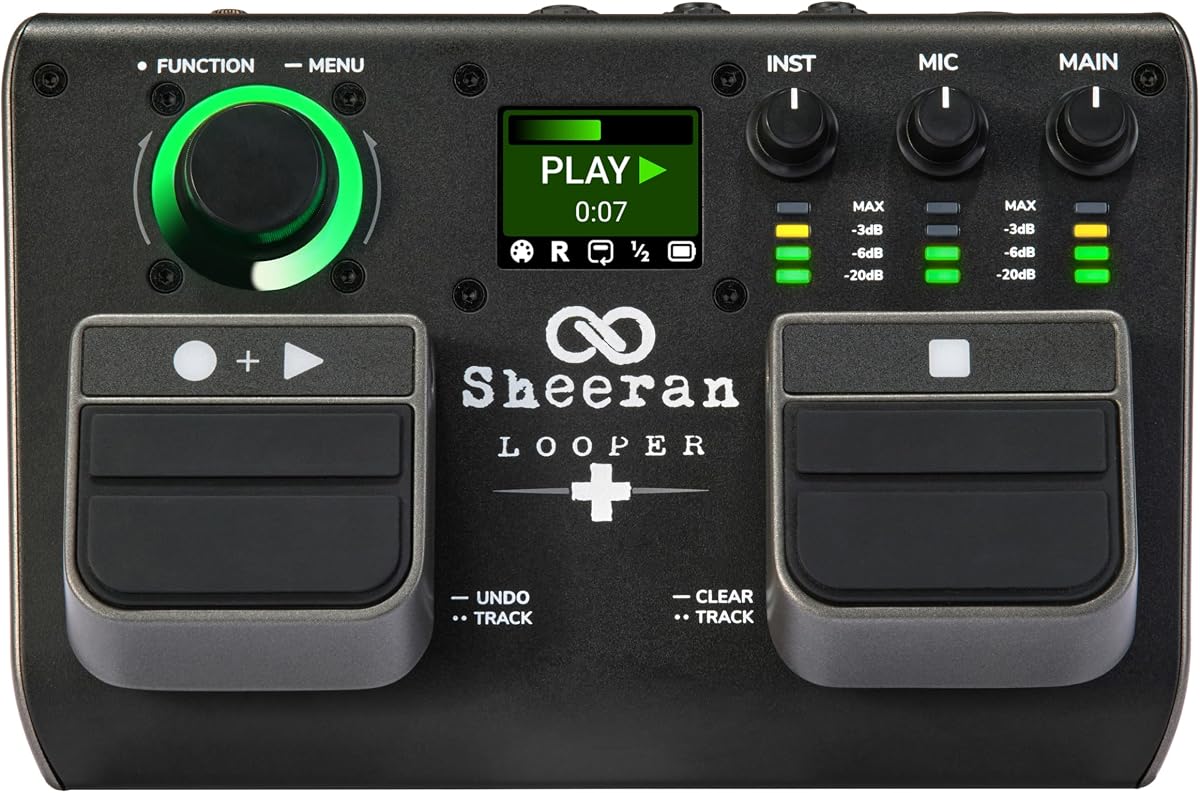
The Sheeran Looper + Dual Track offers unique dual-track looping designed for performers like Ed Sheeran. It supports four modes including single and dual-track, which lets you build songs with rhythmic and melodic layers. The 32-bit audio and 128 loop storage are top-tier for serious users.
We may earn a commission when you buy through this link, at no additional cost to you.
You can use it as a USB audio interface to record directly into a DAW. The full-color display and RGB ring provide clear status feedback during shows. Its rugged steel chassis is built to withstand touring demands, ensuring reliability on stage.
While the features are robust, the price and weight are higher than standard pedals. It requires more setup time to leverage the dual-track modes. However, for solo artists who need a full backing band sound, it is a powerful tool.
This unit is best for musicians who value detailed control and high-fidelity recording. Verify current pricing and bundle options to see if it fits your budget. Check availability to ensure you get the latest firmware and accessories.
Separate tracks for rhythm and melody let you build full arrangements without losing timing.
Connect via USB to record loops directly to your computer for streaming or studio use.
We may earn a commission when you buy through this link, at no additional cost to you.
This LEKATO model improves on its predecessor by including a power adapter. It keeps the same strong features like 40 minutes of recording and a high-sensitivity tuner. Users rate it highly for reliability and ease of use during long sessions.
We may earn a commission when you buy through this link, at no additional cost to you.
The visual time indicator helps you track loops without guessing. Unlimited overdubbing allows you to build up songs piece by piece. Its analog-dry-through design ensures your dry signal remains clean while looping. The USB port supports file transfer for backup.
While it lacks a large screen, its straightforward operation is a plus. You will not get lost in menus during a performance. Some users prefer more memory slots, but this version covers basic needs well for practice and small gigs.
Check current listings to confirm what is included in the box. It is a strong value for players who want both tuning and looping in one compact unit. Verify shipping details and availability before purchasing.
High-sensitivity tuning works without interrupting your loops for seamless transitions between songs.
A visual time display shows you how much space is left in the current loop.
We may earn a commission when you buy through this link, at no additional cost to you.
The TC Electronic DITTO LOOPER is a classic choice for simple looping. It offers 5 minutes of loop time, which is enough for many songs. The undo and redo function gives you flexibility to fix mistakes without stopping the flow.
We may earn a commission when you buy through this link, at no additional cost to you.
Its analog-dry-through and true bypass ensure your tone remains pure. You can stack layers freely and clear them with a single command. The small footprint fits almost any pedalboard. Many artists have relied on this model for years.
While it has fewer features than newer models, its simplicity is its selling point. You do not need to navigate complex menus. The lack of memory means loops disappear when power is cut, but this keeps the signal path clean and simple.
Consider this if you want a no-fuss tool for live jams. It is widely available and affordable. Check current stock to see if it is in high demand and verify any package updates before buying.
Easily remove layers or restore them with a quick footpress if you make a mistake.
Its small size saves space on your board so you can fit more effects.
We may earn a commission when you buy through this link, at no additional cost to you.
The BOSS RC-5 Loop Station is an advanced model with 13 hours of recording and 57 built-in rhythms. It features a multi-color LCD and reverse function for creative textures. Its 32-bit processing ensures professional audio quality across all loops.
We may earn a commission when you buy through this link, at no additional cost to you.
You can save 99 phrase memories for quick recall during sets. Full MIDI I/O and USB connectivity support complex setups. The reverse function lets you flip loops to create unique soundscapes. Its compact design avoids taking up too much space.
While it offers many features, it may require time to set up. Some users find the number of options overwhelming at first. However, the build quality and sound fidelity justify the investment for serious performers.
Check current pricing and warranty details before buying. It is ideal for those who want rhythm accompaniment and high-end looping in one unit. Verify availability to ensure you get the latest version.
57 rhythms with A/B variations provide instant backing tracks for solo performances.
Reverse your loops to add unique textures and experimental sounds to your compositions.
We may earn a commission when you buy through this link, at no additional cost to you.
The Boss RC-600 Loop Station supports six stereo phrase tracks and two XLR inputs with phantom power. It is built for complex live setups where you need to manage multiple instruments. The 99 phrase presets and rhythm guide add flexibility for large performances.
We may earn a commission when you buy through this link, at no additional cost to you.
Its stereo instrument inputs and multiple outputs provide extensive connectivity. You can use it in professional settings with a wide range of gear. The large size may be a drawback for small boards, but the capabilities are unmatched at its tier.
While expensive, it offers a complete looping studio on a pedalboard. Some users may find the menu system deep. However, for full-band integration, it delivers reliable performance and control.
Check if your setup needs this level of detail before investing. It is best for professionals who require multi-track flexibility. Verify current pricing and availability to confirm it fits your budget.
Two XLR inputs with phantom power let you connect microphones directly for vocal looping.
Six stereo tracks allow for complex arrangements with multiple layers of instruments.
We may earn a commission when you buy through this link, at no additional cost to you.
The FLAMMA FF20 combines a looper with a drum machine, offering 220 grooves and 300 minutes of recording. Its time stretch tool lets you change speed without affecting pitch. The 2-inch screen shows BPM and loop status clearly.
We may earn a commission when you buy through this link, at no additional cost to you.
Auto record starts recording with your first note, which helps beginners. Headphone output allows silent practice. USB file transfer makes it easy to manage backups. The dual footswitches simplify control for live use.
While not as deep as high-end models, it is a strong all-in-one solution. Some users may prefer more editing tools. However, for solo players needing rhythm backing, it offers great value and flexibility.
Check current listings to confirm included software and accessories. It suits players who want drum loops without extra gear. Verify shipping details and availability before purchasing.
220 drum grooves give you instant rhythm tracks for practice or performance.
Adjust loop speed without changing pitch so you can match any tempo easily.
We may earn a commission when you buy through this link, at no additional cost to you.
Selecting the right looper depends on your performance needs and technical setup. Below are key factors to consider before purchasing.
Consider how long you need to record per session and how many loops you want to save. Some pedals offer minutes while others provide hours. Memory slots determine if you can recall past loops or start fresh each time.
Choose a model with enough time and memory to avoid interruptions during live sets.
Higher bit depth like 32-bit ensures cleaner loops with less noise. Look for analog-dry-through to keep your tone pure when looping is off. Sampling rate affects clarity for complex tones.
Prioritize models with professional-grade AD/DA conversion for the best sound.
Check for MIDI, USB, and stereo inputs or outputs to match your gear. USB can serve as an audio interface for recording. MIDI enables remote control from switches or computers.
Ensure the pedal supports the connections your other instruments need.
Simple pedals use one button while others have multiple switches or screens. Consider your comfort with menus during a show. Visual indicators help you track loop status.
Pick a control scheme that fits your playing style and experience level.
Some models include drum patterns or time stretch tools for backing. These are useful for solo artists needing rhythm support. Effects like reverse add creative textures to loops.
Look for built-in rhythm if you play without a band.
Metal chassis and rugged build ensure the unit survives touring. Check battery life or adapter requirements for power. Warranty terms offer long-term protection.
Select a durable unit with flexible power options for reliability.
Budget models offer basics while premium units bring advanced features. Compare what you get relative to your needs to avoid overspending. Sales and bundles may improve value.
Find a balance between cost and the features you truly require.
Start by connecting your instrument and effects chain to the input and output jacks. Use a power supply or batteries as specified to avoid voltage issues. Set your volume to match the loop level.
Record your first loop by pressing the record button and playing. Overdub by pressing play again to layer new parts. Use undo or erase to correct mistakes without starting over.
Store loops in memory slots if available and label them clearly. Keep the pedal dry and dust-free when not in use. Update firmware via USB if the model supports it for new features.
For beginners, the BOSS RC-1 or TC Electronic DITTO models are excellent choices. They offer simple controls and reliable looping without complex menus. These options let you focus on building layers without technical stress.
Most loops for songs fit within 5 to 10 minutes. If you create long compositions or practice sessions, look for pedals with 30 minutes or more. Check your typical set length to decide.
Some pedals like the Sheeran Looper + offer USB audio interface features. This lets you record directly into a DAW on your computer. It simplifies the workflow for home recording.
Most pedals use 9V adapters or batteries. Battery life varies, so check specs for long performances. A reliable power supply ensures your loops do not cut off mid-song.
Undo removes the last layer you added so you can fix mistakes. Redo brings it back if you remove too much. This helps build complex loops safely during live performance.
Yes, models like the FLAMMA FF20 include built-in drum machines. They provide 200+ grooves to accompany your loops. This is ideal for solo performers needing rhythm backing.
Use memory slots or presets to save loops on advanced pedals. For simple units, loops may only last until power is cut. Check your model to see if it supports storage.
We highlighted ten top models from beginner-friendly units to high-end multi-track systems. Each offers unique strengths for looping in live or studio environments. The right choice depends on your budget and technical needs.
Focus on features like recording time, memory, and audio quality before buying. Consider your workflow to avoid complexity that slows you down on stage. Match the pedal to your instrument and setup.
Prices and stock vary, so review current listings before finalizing your purchase. Check warranties and included accessories for value. Choose a model that supports your creativity without limits.